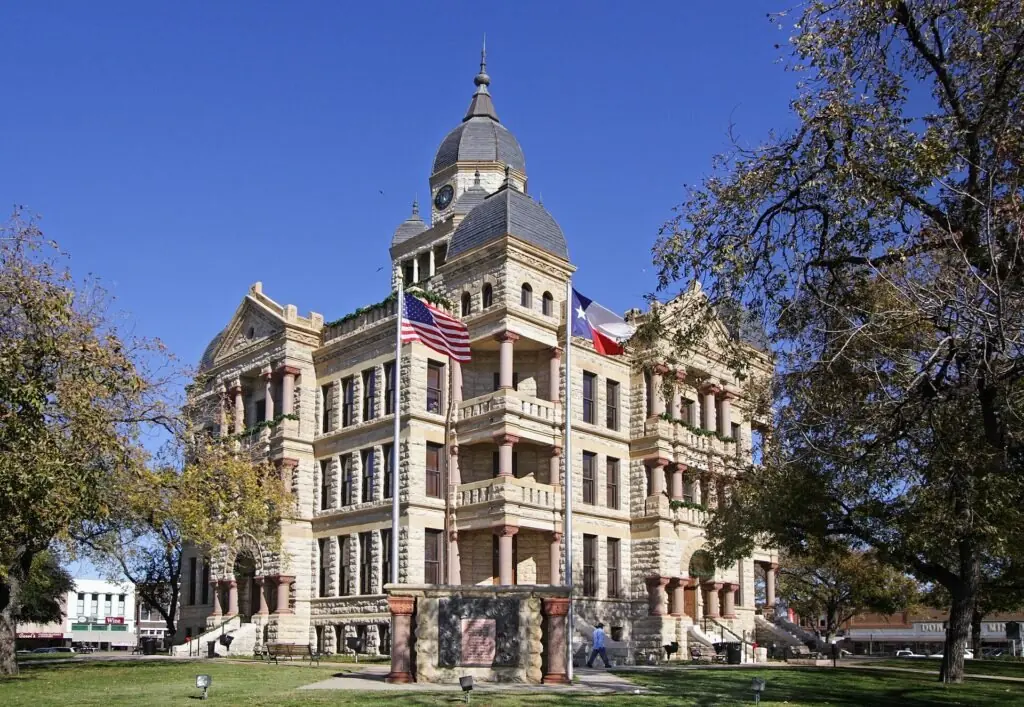
The 1896 courthouse anchors Denton's square, and the neighborhoods around it raise the oldest working chimneys anywhere we serve. Steady hands for century brick, honest care for every ring since. From the courthouse square outward, a chimney sweep in Denton meets a full century of brick, so chimney cleaning comes with a close look at where chimney repair is due.
What exactly do I get for $299 here?
That $299 covers a complete single-flue cleaning together with a Level 1 inspection, done in one visit. Ads at $99 typically list only the base task, leaving the inspection to be billed separately. Denton's chimneys near the 1896 courthouse square have earned that level of care. Why $299, not $99 →
Denton has been a county seat since before its courthouse rose in 1896. The square around that dome still sets the town's rhythm. Music on the lawn, two universities nearby, and historic districts whose chimneys have outlived every trend since gaslight.
Those square-adjacent neighborhoods hold the oldest working chimneys in our entire territory, soft lime mortar, unlined flues, brick fired before the First World War. They can't be serviced like postwar construction, and pretending otherwise is how century chimneys get ruined. Hard modern mortar destroys soft historic brick; we never let it near the old stock.
The Denton toolkit covers a full century of chimney work, including lime-appropriate tuckpointing that flexes like the original. We give honest rebuild assessments when the top courses are worn out. Camera inspections come before any prescription, and flashing repair fits every era's roofline where it meets brick.
The Oak-Hickory historic district and the square-adjacent blocks carry the founders, pre-1930 masonry that earns the careful protocol every visit. The university districts around UNT and TWU mix historic homes with serious rental stock, where documented inspections between tenants are simply good business.
The postwar rings add classic renewal-age brick by the grid, and the newer south toward 380 brings the chase era's metal-topped systems. One town, a hundred years of chimney types, and a checklist for each.
Denton anchors our far north territory up I-35E and 380. Same-week service on dedicated northern route days is the standard. We offer confirmed windows, seven-day scheduling, and time for historic work that shouldn't be rushed.
Old brick whispering? Call (214) 225-8874, steady hands, lime mortar, no shortcuts.
A Typical Denton Project
A 1920s bungalow in the Oak-Hickory blocks had its original chimney, down to an unlined flue. The camera showed tile-less masonry that had earned retirement from wood fires. The top six courses had gone soft past saving. We rebuilt those courses in salvage-matched brick and lime mortar. We repointed the sound sections to blend in. We gave the owner honest options for the flue: gas insert or stainless liner, both priced in writing. The chimney kept its face; the house kept its history. That's the Denton protocol.
Denton takes the northwest corridors' full seasons, spring hail most years, freeze-thaw winters, straight-line spring winds, and its oldest masonry has been absorbing them since before weather had radar. Lime mortar handles a century of that gracefully when it's respected, and fails fast when a past repair sealed it behind hard modern cement. Half our historic work here starts by undoing someone's shortcut.
The standard never aged out: NFPA 211 calls for annual inspection of every chimney, guidance the Chimney Safety Institute of America lays out for homeowners. On pre-1930 flues, that yearly look isn't maintenance advice, it's the whole safety case.
Pre-1930, the square blocks and Oak-Hickory: the territory's oldest, lime-mortar protocol always. The university districts, historic and rental stock mixed, documentation-first. The postwar rings, original equipment at renewal age. The newer south, chase-era systems on the metal-cover clock.
Photos before prices, camera before prescriptions, and repairs that disappear into original work, the square has watched craftsmen come and go for 130 years, and it can tell the difference. The before-and-after gallery shows the standard; the reviews hold us to it.
Denton anchors the far north of our territory up I-35E and 380. We're honest about it: same-week is the standard, not FAST-scheduling. Jobs are batched onto dedicated northern route days. Seven days a week, 8AM to 8PM, window confirmed the day before, and historic work gets the schedule room it deserves.
Denton spans the widest age range in our territory. The square-adjacent historic districts carry pre-1930 problems: soft lime mortar, unlined flues, and chimneys weighing rebuild-versus-repair questions. The postwar rings add classic renewal work, the university districts add rental-documentation needs, and the newer south brings chase-era systems. One city, a full century of chimney types.
Yes, and the honest version of that answer matters. Century chimneys need lime-appropriate mortar that flexes like the original, since hard modern mortar destroys soft historic brick. They need camera inspections before any prescription. They also need a straight answer when a rebuild of the top courses is right, not another patch. We give all three, with photos at every step.
The blocks around the 1896 courthouse square hold the seniors, the Oak-Hickory historic district and the square-adjacent streets carry Denton's founding masonry, some of it predating the courthouse itself. These are the oldest working chimneys anywhere in our service territory, and they get our most careful protocol: camera first, lime mortar always, honesty about age.
Regularly, two universities make Denton a serious rental town, and landlords book documented inspections between tenants for exactly the right reasons. A photo report proving the flue, damper, and firebox were checked before move-in protects the tenant, the property, and every deposit conversation after. Most college-district floor plans take under an hour.
It affects the how, not the whether. Districts like Oak-Hickory expect repairs that respect the streetscape. This means era-appropriate mortar color, joint profiles, and matching brick when replacement is needed. It also means documentation a preservation-minded reviewer can approve without a second meeting. Done right, the repair disappears into the original work, which is the standard we hold anyway.
The seasonal swell-and-shrink affects everything here, but it hits century foundations hardest. Pier-and-beam originals and early slabs move differently than modern construction. Their chimneys show it at the roofline seam and in stair-step cracks through old mortar. Stable hairlines are aging; movement that grows season over season earns measurement, photos, and a plan.
Denton sits square in the northwest corridors, so yes, regularly. The pattern matches the region: roofs replaced on insurance while chimney tops stayed off the claim. On century chimneys the stakes run higher, because a hail-cracked crown lets water into masonry that's already earned gentler treatment. A newer roof than chimney top is worth noticing right away.
Late summer through September beats the rush and suits our northern route days best; lime mortar and rebuild work want the warm months for proper curing. For any pre-1930 flue that has never seen a camera, and Denton has more of those than anywhere we serve, before the first fire isn't advice, it's the rule.
Our northern routes pair Denton with Frisco and McKinney across the 380 corridor. Closer in, Corinth, Highland Village and Lewisville each have their own page. The full list is on our service areas page.
Free online quotes · Lime-mortar literacy · Rebuild honesty · Open 7 days
(214) 225-8874📍 1008 Ridgefield Dr, Plano TX 75075 | 🕗 Open 7 days · 8AM-8PM
"Very pleased with the professionalism and promptness of service. The chimney sweep was done quickly and efficiently at significantly less cost than the first quote I got from another company. Happy to recommend Lowes Chimney Sweep to anyone in Plano!"
"Outstanding chimney sweep service from start to finish. They were punctual, courteous, and left our chimney spotless with no mess in our home. I won't use anyone else for chimney services in Dallas TX!"
More reviews from homeowners across the metroplex are on our reviews section, or learn more about our team before you book.
Full-service chimney care across Denton and the DFW metroplex.
Helpful guides: