Frisco built a hundred thousand rooftops in twenty years, and almost none of those chimneys are what they look like. We're the next-door company that knows exactly what's under the stone veneer. In a city this new, a chimney sweep in Frisco is mostly chimney cleaning on prefab flues, plus chimney repair on chase covers and caps that Texas hail finds first.
Why is $299 higher than the $99 ad I saw?
Those $99 ads usually list a starting number, and the inspection often gets added afterward. Our $299 price already includes both a single-flue cleaning and a Level 1 inspection. Frisco's rooftops went up so fast that most chimneys hide more than the stone veneer suggests. Why $299, not $99 →
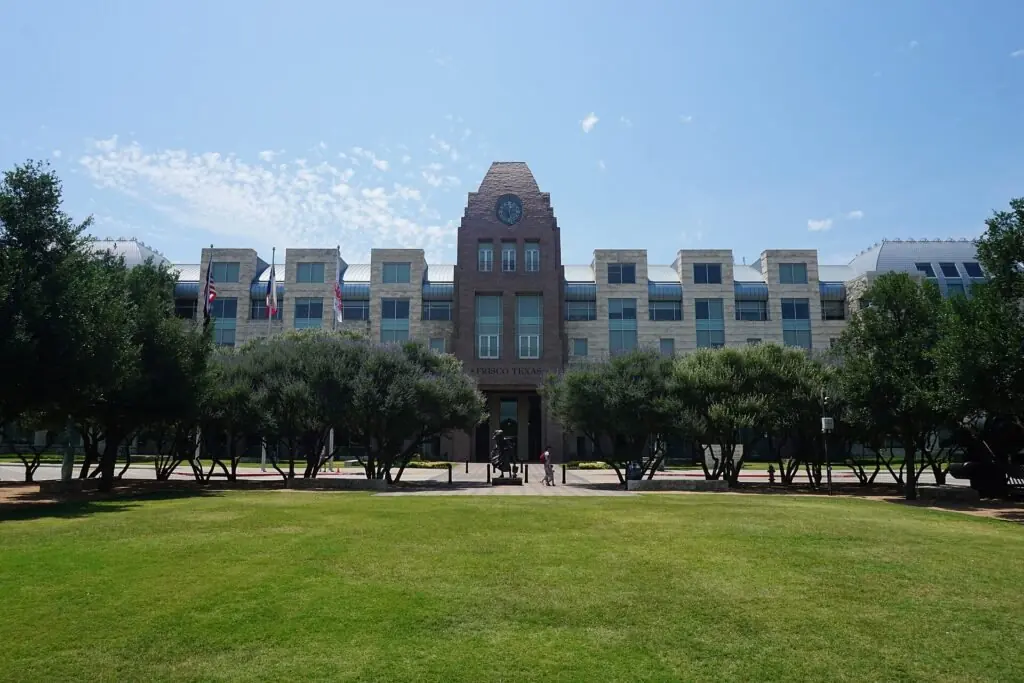
Frisco is named for a railroad, the St. Louis-San Francisco line whose tracks still cross the old Rail District downtown. In 1990 this was a farm town of about six thousand people. Then the metroplex arrived, and for two decades Frisco ranked among the fastest-growing cities in America.
That history is written on the rooftops. Frisco's chimneys are as new as the city, and that's exactly their problem. They were nearly all built in the same twenty-year sprint, with the same builder-grade components, and now they're aging into their first failures together, subdivision by subdivision.
Walk any street in Starwood or Phillips Creek Ranch and you'll see handsome brick and stone chimneys, but most aren't solid masonry. They're framed chases: wood-built columns wrapped in veneer, housing a factory fireplace, topped by a sheet-metal chase cover. Nothing wrong with the design. Everything wrong with the galvanized cover the builder chose, ten to fifteen years later.
The work we do most in Frisco isn't tuckpointing. It's stainless steel chase cover replacement, hail-resistant cap installation, and gas fireplace service for switch-lit homes. We also run camera inspections showing new owners what builders installed.
The Rail District holds Frisco's only genuinely old bones, the compact original downtown where a rare true-masonry chimney still turns up. Starwood and the Stonebriar corridor carry the first boom wave, late-'90s and 2000s homes whose original covers and caps are past due. Phillips Creek Ranch and Newman Village represent the 2010s: newer, but already meeting their first Texas hail. And the blocks rising around Frisco Square are newest of all, builder-warranty territory where a first independent inspection pays for itself.
Logistics are the easy part: the shop is in Plano, straight down the tollway, which makes Frisco our second-fastest response zone after our own home city. FAST-scheduling visits are routine, and evening appointments up to 8PM fit commuter schedules.
Do any of these show up on your Frisco home? Call (214) 225-8874, we're ten minutes down the tollway.
A Typical Frisco Project
In a 2008 Starwood two-story, rust bled down the stone-wrapped chase after fifteen North Texas summers. We measured the chase and fabricated a stainless cover with a proper cross-break and storm collar. We photographed the swap and left the owner an HOA-ready spec sheet. Two hours on site; a builder-grade problem retired permanently. That's the most Frisco job there is.
Frisco's homes may be new; the weather auditioning them is not. This hail alley battered Frisco in the famous 2016 and 2017 spring storms. Local roofers still date their calendars by those storms. The same Blackland Prairie clay flexes foundations through every wet-dry cycle, printing hairline stair-step cracks into veneer. Add summers that bake sealants and galvanized coatings past their design life, and "new construction" stops being a maintenance plan around year ten.
The rulebook doesn't grade on age either. NFPA 211 calls for an annual inspection of every chimney and venting system, gas included. The Chimney Safety Institute of America explains this guidance in plain terms. In Frisco, that annual look is usually fast, cheap, and exactly how a thirty-dollar gasket stays a thirty-dollar gasket.
Before 1995, the Rail District and original core: Frisco's rare true masonry, treated with the respect old brick earns. 1995 to 2005, Starwood, Stonebriar corridor: first-generation boom homes whose builder covers and caps are past their window now. 2005 to 2015, the peak wave, Phillips Creek Ranch to Panther Creek: entering the failure years as a group. 2015 and newer, around Frisco Square and the far west: warranty territory, where the first independent inspection sets the baseline.
Frisco moves fast; the standard doesn't change. Photos before prices, written quotes, no upsells, whether it's a chase cover in Newman Village or the Rail District's oldest brick. The before-and-after gallery shows the work, and the reviews come from neighbors ten minutes down the tollway.
Frisco is next door, the shop sits in Plano just down the Dallas North Tollway, which makes Frisco our second-fastest coverage zone after our home city. FAST-scheduling service is routine, and evening slots up to 8PM work well for commuter households. Seven days a week.
Frisco's housing is young, so its problems are specific. Builder-grade galvanized chase covers rust through right on schedule, at the ten-to-fifteen-year mark. Caps and crowns got dinged by two famous hail seasons, and gas fireplace systems are overdue for their first real service. Traditional masonry problems are rare here, because most Frisco chimneys aren't solid masonry at all.
Yes, and the standard says so: NFPA 211 calls for annual inspection of every chimney and venting system regardless of fuel. Gas burns clean, but venting still corrodes, birds still nest, and factory-built systems still shift with the house. A Frisco-typical annual visit is quick, and it's the difference between catching a thirty-dollar gasket and replacing a firebox.
Math. Frisco built tens of thousands of homes between roughly 2000 and 2015. Nearly all had factory fireplaces in framed chases topped by builder-grade galvanized covers. These covers last about ten to fifteen years in Texas weather. The city's housing stock is now aging into that window together, which is why rust streaks on stone veneer have become Frisco's signature chimney problem. The fix is a custom stainless cover: once, done right, done forever.
Look at the top from the yard. A flat metal pan with a round pipe and small cap poking through means a framed chase with a factory fireplace. This is standard for most of Frisco, even when the sides show brick or stone veneer. Solid masonry shows a concrete crown with a square clay flue tile. The distinction decides which repairs your home will ever need, so it's the first thing we confirm and photograph.
The master-planned communities do, Starwood, Newman Village, Phillips Creek Ranch and their peers keep exterior standards tight. The good news: a properly fitted stainless chase cover or color-matched repair usually reads as an upgrade, not a change. We provide the photos and spec sheet an architectural review committee wants to see.
Insurers are still processing the memory. Those spring storms dropped giant hail across Frisco and its neighbors. Roofs got replaced quickly, but chimney tops often weren't part of the claim. Dented caps, creased chase covers, and chipped crowns quietly stayed behind. If your roof was replaced after hail but nobody photographed the chimney, that inspection is unfinished business.
Same clay, same physics. Frisco sits on the Blackland Prairie's expansive soil. Slab movement telegraphs into the stone and brick veneer that wraps most chases. Hairline stair-step cracks after a hot, dry summer are the classic sign. Veneer cracks caught early are usually minor; the same visit that confirms it also checks the cover and flashing above.
Gas-system households should book in early fall, before the first-use rush, the week everyone flips the switch is the week the calendar fills. Chase cover replacements are smartest in the calm of summer. And post-hail checks belong in the same season as the storm, while insurance timelines are still friendly.
The crews covering Frisco come straight through Plano, our home city, and work McKinney and Little Elm daily. Every other DFW town we cover is on the service areas page.
Free online quotes · Custom stainless chase covers · Gas fireplace specialists · Open 7 days
(214) 225-8874📍 1008 Ridgefield Dr, Plano TX 75075 | 🕗 Open 7 days · 8AM-8PM
"Very pleased with the professionalism and promptness of service. The chimney sweep was done quickly and efficiently at significantly less cost than the first quote I got from another company. Happy to recommend Lowes Chimney Sweep to anyone in Plano!"
"Outstanding chimney sweep service from start to finish. They were punctual, courteous, and left our chimney spotless with no mess in our home. I won't use anyone else for chimney services in Dallas TX!"
More reviews from homeowners across the metroplex are on our reviews section, or learn more about our team before you book.
Core chimney services: Chimney Sweep · Chimney Repair · Chimney Cleaning · Chimney Inspection
Every service we offer Frisco homeowners, from a routine sweep to a full rebuild.
Helpful guides: