● Pricing reviewed & current for October 2026
A properly built chimney cricket sends rain, hail runoff, and roof debris around your chimney instead of trapping it behind the masonry. Lowes Chimney Sweep designs, builds, and flashes crickets and saddles for homes across the DFW metroplex.
Quick answer: A chimney cricket installation in Dallas-Fort Worth typically costs $300 to $800 in 2026, depending on chimney width and roof pitch.
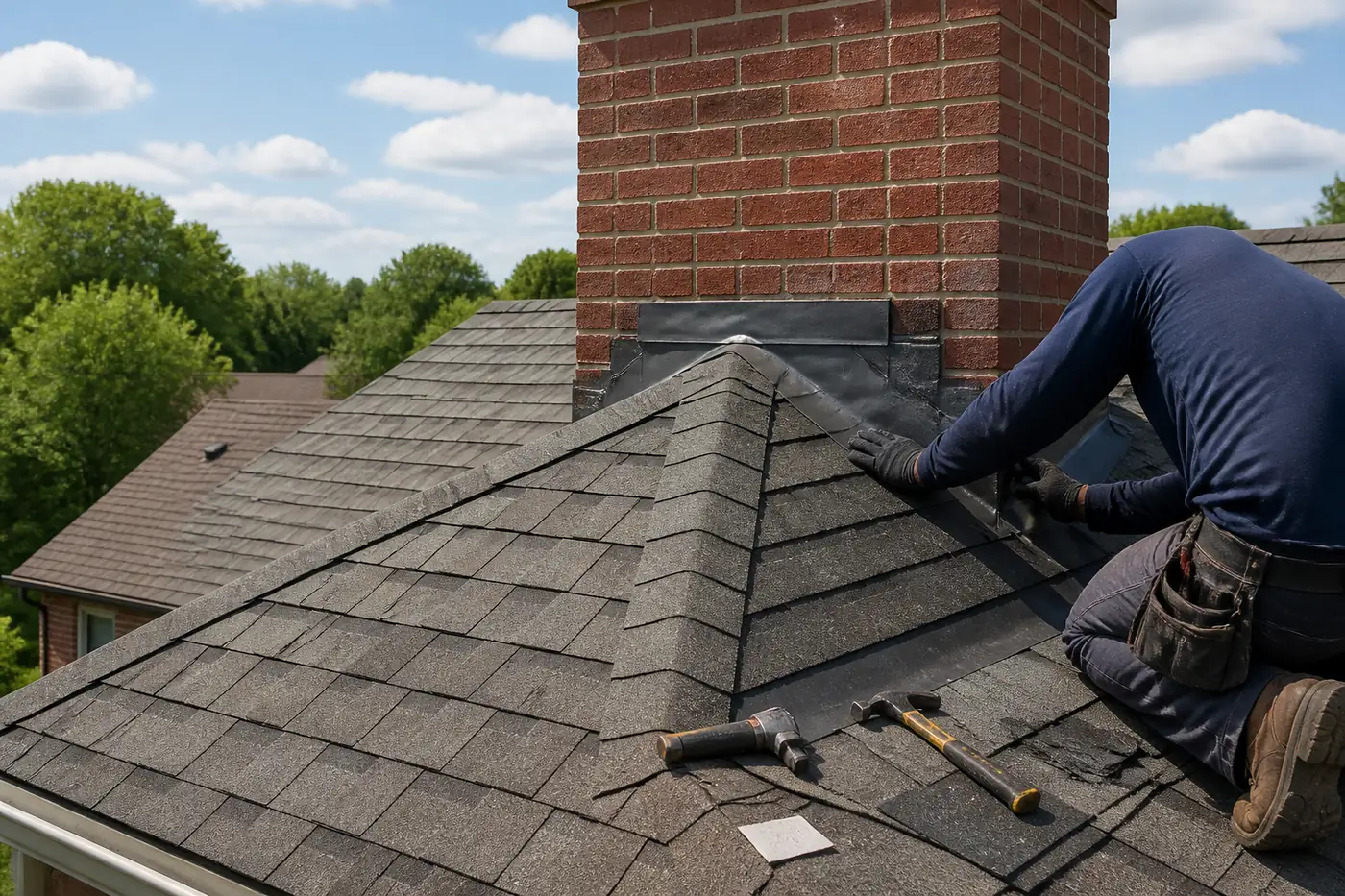
A chimney cricket, also called a chimney saddle, is a small peaked structure built on the up-slope side of your roof, directly behind the chimney. Picture a miniature ridged roof, tucked against the back of the masonry, with two sloped planes that meet at a center ridge. That ridge splits the water and channels it left and right, around both sides of the chimney, so it can continue down to the gutters instead of slamming into the back wall and stopping.
It is a simple idea that solves a stubborn problem. On any sloped roof, water and debris travel downhill. A chimney sitting in that path acts like a dam. Without a cricket, everything that flows down the roof piles up behind the chimney, sits against the flashing, and looks for a way in. With a cricket, that same water is politely diverted around the obstacle and sent on its way. The cricket is not decorative and it is not optional on wider chimneys. It is a working piece of your roof and chimney system, and when it is missing or poorly built, the damage shows up fast in a climate like ours.
Every chimney that rises through a sloped roof creates a low pocket on its up-slope side. Rain running down the roof hits the back of the chimney and has nowhere to go, so it spreads sideways and lingers. Leaves, twigs, shingle grit, and here in Texas plenty of hail debris get carried down with the water and settle in that same pocket. Over time you get a wet, packed mound of organic material sitting against the masonry and the flashing joint.
That standing water is the enemy. Roofing and flashing are designed to shed water quickly, not to hold it. When water pools behind a chimney, it works into the seams, saturates the mortar and brick, and finds the smallest gap in the flashing. Freeze-and-thaw swings, which North Texas gets more of than people expect, expand that trapped moisture inside the masonry and crack it apart. Debris dams make it worse by holding moisture against the structure long after the rain stops. A cricket eliminates the pocket entirely, so there is no place for water or debris to collect in the first place.
Building code offers clear guidance here. As a general rule, when a chimney is wider than about 30 inches measured across the up-slope side, and it penetrates a sloped roof, a cricket or saddle is required. The wider the chimney, the bigger the dam it creates and the more water it blocks, which is exactly why the code draws the line where it does. Narrow chimneys under that threshold can often shed water adequately with proper flashing alone, but once you cross into wider masonry, a cricket becomes a code and performance necessity.
The steeper the roof and the wider the chimney, the taller the cricket needs to be to do its job. Our team measures the chimney width, evaluates the roof pitch, and builds a cricket sized and angled correctly for your specific roof. This is not a one-size-fits-all part you pull off a shelf. A cricket that is too short or too shallow will still let water back up behind the chimney, so getting the geometry right is the whole point. If your chimney is wide and currently has no cricket, you are very likely out of compliance and, more importantly, at real risk of water damage.
Most homeowners do not think about crickets until water finds its way inside. There are earlier warning signs, though, and catching them saves you from bigger repairs. Watch for these:
Ceiling or wall stains near the chimney chase are the classic red flag, especially brownish rings that grow after heavy storms. Damp or musty smells in the attic around the chimney penetration point to trapped moisture. When you or your roofer look at the roof, a visible mound of packed leaves, grit, and debris behind the chimney means water is pooling exactly where it should not. Rusty, lifted, or separating flashing on the back side of the chimney is another strong indicator that standing water has been attacking the seam. Inside, you may see peeling paint, crumbling drywall, or efflorescence, the white chalky residue that appears when water moves through masonry.
Any of these signs on a chimney wider than 30 inches usually traces back to a missing or failed cricket. If you are already dealing with active leaks, our chimney leak repair team can find the entry point and stop the water, then we address the root cause with a proper cricket so the problem does not return.
A cricket has to be built as an integrated part of the roof, not tacked on afterward. Our process starts with accurate measurements of the chimney width and the roof slope, because those two numbers determine the size and pitch of the cricket. From there we frame the structure, typically with treated lumber, to create the two sloped planes that meet at a center ridge behind the chimney. That framing gets sheathed with plywood or OSB to form a solid, watertight deck.
Once the structure is framed and decked, we install the underlayment and then finish the surface to match and integrate with your existing roof, usually with matching shingles or, on some installations, with soldered sheet metal for a fully waterproof saddle. The final and most critical step is tying the cricket into the roof and chimney with correctly layered flashing. The cricket, the flashing, and the roofing all have to overlap in the right order so that water is always directed on top of the layer below it and never behind it. When that layering is done right, the cricket sheds water flawlessly for the life of the roof.
A cricket is only as good as the flashing that connects it to your chimney and roof. This is where a lot of amateur and rushed installations fail. Flashing has to be step-flashed up the sides, counter-flashed into the masonry mortar joints, and lapped correctly over the cricket's sloped surfaces so every seam sheds water downhill onto the next layer. Skip a lap, reverse an overlap, or rely on caulk instead of proper metalwork, and you have simply moved the leak a few inches.
We treat the cricket and the flashing as a single system. If your existing flashing is rusted, lifted, or improperly installed, we replace and re-integrate it as part of the cricket job rather than reusing compromised metal. For homes where the flashing is the primary issue and the chimney does not require a full cricket, our chimney flashing repair service handles that directly. But on a cricket installation, doing the flashing correctly is non-negotiable, because it is the seam where the new structure meets your existing roof and chimney.
The right materials depend on your roof and your chimney. For most residential installations, we frame the cricket in treated lumber and sheath it in exterior-grade plywood or OSB, then finish it with shingles that match your existing roof for a clean, seamless appearance. On larger chimneys, low-slope situations, or where a client wants maximum longevity, we build a metal saddle from galvanized steel, aluminum, or copper, with soldered seams for a fully waterproof finish.
Flashing metal is chosen to hold up to North Texas weather, which means resisting the corrosion that comes from repeated wet-dry cycles and the impact of hail. We match the flashing material to the roof and the counter-flashing to the masonry so everything works together and ages together. Quality materials matter here because a cricket, like flashing, is something you want to install once and never think about again. Cutting corners on materials is how a five-figure water-damage repair starts a few years down the road.
Every roof is different, so we price each cricket installation based on the actual conditions. The main factors are the width of your chimney and the pitch of your roof, since those determine the size of the cricket and how much framing and material the job requires. A wide chimney on a steep roof needs a larger, taller cricket than a modest chimney on a gentle slope.
Other cost factors include the finish material you choose, shingle-matched versus a soldered metal saddle, the condition of your existing flashing and whether it needs full replacement, roof height and accessibility, and whether there is existing water damage to the deck or framing that needs repair before the cricket goes on. Homes with active leaks sometimes need remediation first. We give you a clear, itemized estimate up front after inspecting the roof, so you know exactly what you are paying for and why. No surprise add-ons and no vague guesses.
North Texas is exactly the climate where a chimney cricket earns its keep. We get sudden, heavy downpours that dump enormous volumes of water in a short window, and a chimney without a cricket simply cannot move that much water around itself fast enough, so it backs up and pushes into the flashing. We get hail that batters roofs and knocks loose grit and debris, all of which washes down and collects behind chimneys. And we get real freeze-thaw cycles in winter that turn any trapped moisture into cracked masonry.
Serving Plano, Dallas, and 98 cities across the DFW metroplex, Lowes Chimney Sweep has seen what our weather does to chimneys built without proper water diversion. That is why we build crickets sized and flashed for local conditions rather than generic minimums. We are certified and insured, five-star rated, and we offer same-day service and Sunday appointments because water damage does not wait for a weekday. When a storm exposes a problem behind your chimney, you can reach us quickly and get it handled right.
If your chimney is wider than about 30 inches, sits on a sloped roof, and has no cricket, or if you are seeing stains, debris buildup, or failing flashing behind the chimney, it is worth having it inspected now rather than after the next big storm. A cricket installed correctly today prevents years of water damage to your masonry, flashing, ceilings, and framing.
Call Lowes Chimney Sweep at (214) 225-8874 to schedule an inspection and a clear, no-pressure estimate. We will measure your chimney and roof, tell you honestly whether a cricket is required, and build one that sends water where it belongs, around your chimney and off your roof, for good.
"Very pleased with the professionalism and promptness of service. The chimney sweep was done quickly and efficiently at significantly less cost than the first quote I got from another company. Happy to recommend Lowes Chimney Sweep to anyone in Plano!"
"Outstanding chimney sweep service from start to finish. They were punctual, courteous, and left our chimney spotless with no mess in our home. I won't use anyone else for chimney services in Dallas TX!"
More reviews from homeowners across the metroplex are on our reviews section, or learn more about our team before you book.
Chimney cricket installation in Dallas-Fort Worth typically costs $300 to $800 in 2026. The price depends on the width of the chimney and the roof pitch, which set the size of the cricket and the flashing work involved. We measure and quote before building.
A chimney cricket is a small peaked, ridged structure built on the up-slope roof side behind your chimney. Its ridge splits water and debris and diverts them around both sides of the chimney instead of letting them pool against the back masonry and flashing.
Yes. Chimney cricket and chimney saddle are two names for the same structure. Both refer to the peaked diverter built behind a chimney to route water around it. Some people also call it a chimney diverter, but the function is identical.
As a general guideline, a cricket is required when a chimney is wider than about 30 inches on the up-slope side and penetrates a sloped roof. Wider chimneys block more water, so code calls for a cricket to prevent pooling and leaks.
Common signs include water stains on ceilings or walls near the chimney, a mound of leaves and debris packed behind the chimney, rusted or lifting flashing on the back side, and musty smells in the attic. A wide chimney with no cricket is a strong indicator.
Yes. Flashing is integral to a working cricket. We step-flash, counter-flash into the masonry, and layer everything so water always sheds downhill onto the layer below. If your existing flashing is compromised, we replace and re-integrate it as part of the installation.
Most residential cricket installations are completed in a day, depending on chimney width, roof pitch, finish material, and whether there is existing water damage to repair first. We provide a clear timeline and itemized estimate after inspecting your roof.
Straight answers from our DFW chimney pros before you book.
Get an honest ballpark range for this service, no phone call needed. Built from real Dallas-Fort Worth pricing, then book when you’re ready.
Get My Instant Estimate →