● Pricing reviewed & current for October 2026
The smoke chamber is the one part of your chimney most sweeps rush past, and it's where dangerous creosote quietly builds. Lowes Chimney Sweep cleans it right, every time, for homeowners across the Dallas-Fort Worth metroplex.
Quick answer: A chimney smoke chamber cleaning in Dallas-Fort Worth costs $500 to $1,500 in 2026, with a free written quote before any work begins.
Most people know a chimney has a firebox where the logs burn and a flue that carries smoke up and out. What they don't picture is the space in between. Directly above your firebox sits the damper, and directly above the damper sits the smoke chamber: a funnel-shaped transition zone with sloped walls that taper inward and guide smoke from the wide firebox opening up into the much narrower flue. Think of it as a chimney's shoulders, the angled section that pulls everything toward the neck.
That funnel shape isn't decorative. It exists to compress the rising smoke and gases into a smooth, fast column so your fireplace drafts properly and pulls smoke away from your living room instead of into it. When the smoke chamber is built and maintained correctly, air moves through it cleanly. When it isn't, that same shape becomes a trap, and the walls that are supposed to guide smoke start collecting the residue smoke leaves behind. Understanding this small space is the first step to understanding why it matters so much to your safety.
Here's the uncomfortable truth in our trade: the smoke chamber is the single most commonly neglected part of the chimney. It's tucked up above the damper, out of easy sight and out of easy reach. To inspect and clean it properly, a technician has to get past the damper, work at an awkward upward angle, and often reach into a cramped, sooty cavity by hand and with specialized tools. It takes time, patience, and the right equipment.
A lot of "$49 chimney sweep" operations don't do that work. They run a brush up the flue, sweep out the firebox, vacuum the hearth, and call it done. The flue looks clean and the customer sees a tidy fireplace, but the smoke chamber above the damper never got touched. Because homeowners can't see up into that space, they have no way of knowing it was skipped. Year after year the buildup compounds in a spot nobody is looking at. This is exactly why we tell DFW homeowners to ask any company directly whether the smoke chamber is included in the cleaning, because for a lot of them, it quietly isn't.
Every wood fire produces smoke, and that smoke carries unburned particles, water vapor, and combustion gases. As those gases rise and hit the cooler surfaces of the smoke chamber, they condense and leave deposits behind. That residue is creosote, and it comes in stages: a light, flaky soot at first, then a sticky, tar-like layer, and eventually a hard, glazed coating that looks almost like black glass. The smoke chamber is one of the first places creosote accumulates because it's where hot gases slow down, swirl, and cool at that critical transition point.
The shape of the smoke chamber makes it worse. Those angled, shelf-like walls give creosote endless ledges and pockets to cling to. And because so many sweeps skip this area, the deposits are rarely cleaned out. What starts as a thin film becomes a thick, layered crust over several burning seasons. Glazed, third-degree creosote is the most dangerous kind, highly flammable and very difficult to remove, and the smoke chamber is a prime spot for it to form unnoticed.
Creosote is fuel. When it accumulates in the smoke chamber, you have a concentrated layer of flammable material sitting directly in the path of every fire's heat and stray sparks. If it ignites, you get a chimney fire, and chimney fires can reach temperatures high enough to crack flue liners, damage masonry, and spread into the surrounding structure of your home. A smoke chamber packed with glazed creosote is one of the most common ignition points, precisely because it's the part that gets cleaned the least.
There's a second danger that's quieter but just as serious. Heavy buildup narrows the smoke chamber and disrupts the smooth airflow it's supposed to provide. When the funnel gets choked, your chimney can't draft properly. Smoke backs up into the room, and more importantly, so can carbon monoxide, an odorless, colorless gas that's dangerous at low levels and deadly at high ones. A restricted, dirty smoke chamber puts your family at risk both from fire and from what you can't see or smell. This is why we treat this space as non-negotiable on every cleaning.
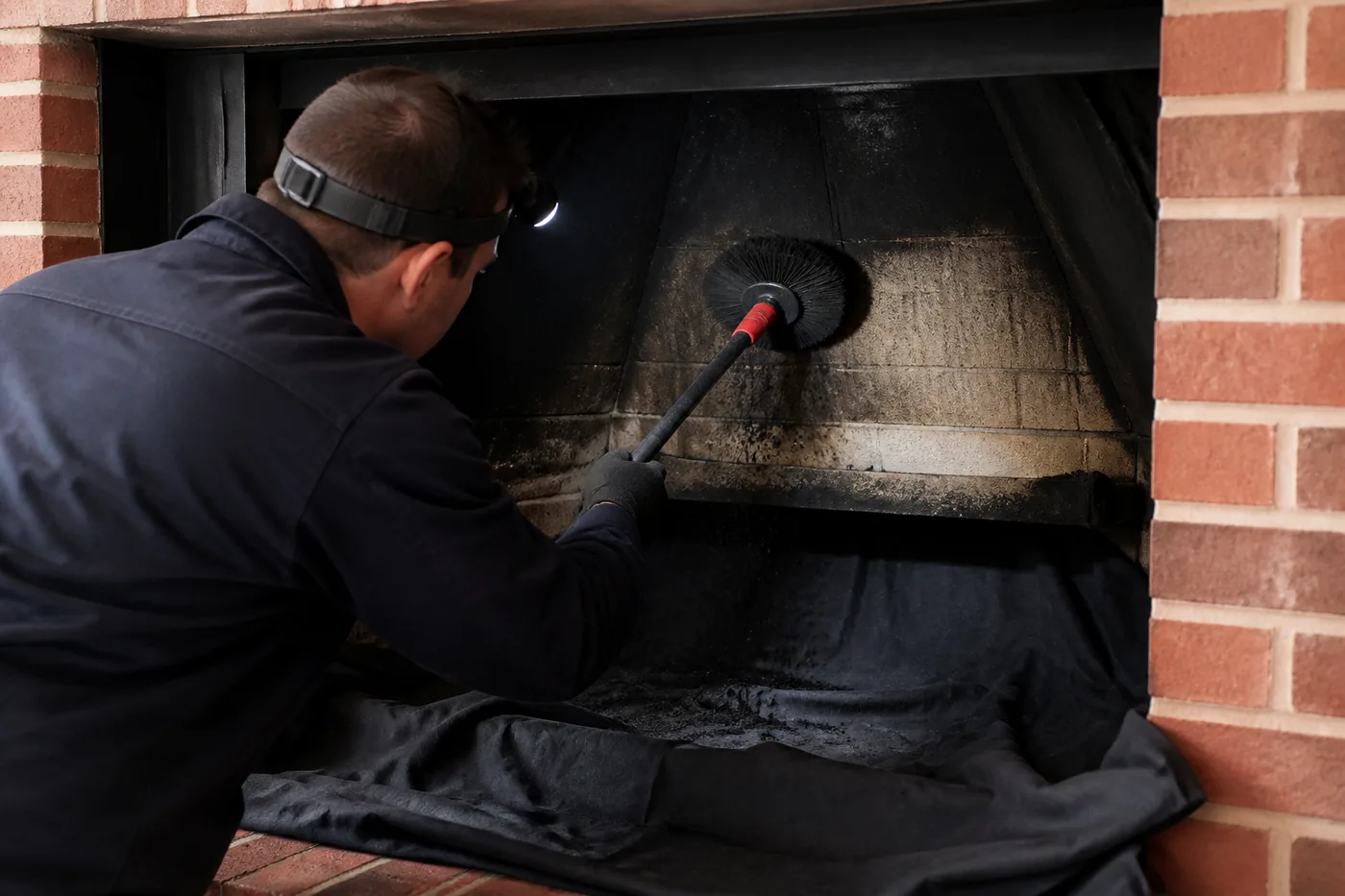
When our certified technicians arrive, we start with a full inspection so we can see the actual condition of your smoke chamber before we touch it. We open the damper and use bright lighting and, where needed, a camera to look up into the chamber and assess how much creosote is present and what type it is. That tells us exactly what the space needs rather than guessing.
From there we set up containment to protect your home, laying down drop cloths and running a HEPA-rated vacuum to control soot and dust so nothing settles on your floors or furniture. We clean the smoke chamber directly, using specialized rotary tools, hand brushes, and scrapers sized to reach up past the damper and work along those angled walls. For light, flaky soot, brushing and vacuuming does the job. For sticky or glazed creosote, we step up to more aggressive rotary heads and, when appropriate, professional-grade removal methods designed to break down hardened deposits without damaging the masonry. We clean the shelf, the walls, and every ledge where residue hides, then vacuum it all out. When we're finished, we do a second look to confirm the chamber is genuinely clean, not just brushed over. Thorough cleaning here is the whole point of the service, and it's exactly what the cheap sweeps leave out.
Cleaning and repair are two different things, and sometimes clearing out years of buildup reveals a problem underneath. Many older smoke chambers, especially in homes built before modern code, were constructed with a corbeled method, meaning the masonry was stepped inward brick by brick to form the funnel. That leaves a rough, jagged surface full of gaps and ledges. Worse, a lot of these chambers were never parged, meaning the interior was never coated with a smooth layer of refractory mortar. An unparged, corbeled smoke chamber has far more surface area for creosote to grab onto and far more turbulence in the airflow, which makes buildup faster and drafting weaker.
Parging is the fix. It's the process of applying a smooth, heat-resistant coating over those rough walls so the surface becomes even, creosote has fewer places to cling, and smoke flows freely. If our cleaning uncovers an unparged surface, deteriorated mortar, cracks, or gaps in the smoke chamber, we'll show you what we found and walk you through your options. That work falls under smoke chamber repair, which addresses the structure itself rather than just the soot on top of it. We'll never push a repair you don't need, but when the safety of the chamber depends on it, we'll tell you plainly and let you decide.
Because you can't see up into the smoke chamber yourself, you have to watch for the symptoms it produces. Smoke rolling back into the room when you light a fire is a classic sign that the chamber is restricted and your chimney isn't drafting the way it should. A strong, tarry, or campfire-like odor coming from the fireplace, especially in DFW's humid summer months, often means creosote has accumulated somewhere in the system, and the smoke chamber is a frequent culprit.
Other warning signs include fires that seem hard to keep going, visible soot or debris falling into the firebox, and a general feeling that your fireplace "doesn't pull like it used to." If you've had cheap sweeps in the past, or you're not certain the smoke chamber has ever been properly cleaned, that alone is reason to have it checked. And if it's been more than a year since your last thorough cleaning, or you burn frequently through the winter, don't wait for symptoms. The safest approach is an inspection that actually includes this overlooked space.
Smoke chamber cleaning is usually part of a complete chimney service, and the price depends on real factors rather than a flat gimmick rate. The biggest one is the amount and type of buildup. Light, flaky soot cleans quickly, while thick or glazed creosote takes more time, more aggressive tools, and sometimes specialized removal products, all of which affect the labor involved. The construction of your chamber matters too; a rough, unparged, corbeled chamber holds more residue and takes longer to clean thoroughly than a smooth one.
Access plays a role as well. Some dampers and chambers are easy to reach, and others are tight or awkwardly built, which adds time. How long it's been since the last real cleaning is another factor, since neglected chambers with several seasons of buildup simply take more work. We give honest, upfront pricing after we've looked at your specific chimney, so you know what you're paying for and why. What we won't do is quote you a suspiciously cheap number and then skip the very part of the job that keeps you safe.
Lowes Chimney Sweep is based in Plano and serves 98 cities across the Dallas-Fort Worth metroplex, from Frisco and McKinney to Fort Worth, Arlington, Irving, Garland, and everywhere in between. North Texas has its own particular demands on a chimney. Our humid summers accelerate creosote odors and can worsen moisture problems inside a dirty chamber, and our cold snaps mean homeowners fire up their fireplaces hard and fast when winter finally arrives. Both conditions make a properly cleaned smoke chamber more important, not less.
We're certified, fully insured, and 5-star rated, and we offer same-day service as well as Sunday appointments because we know a chimney problem doesn't wait for a convenient weekday. Smoke chamber cleaning is one piece of a complete chimney sweep, and when you book with us you get the whole system cleaned, not just the parts that are easy to reach. If you've dealt with sweeps who skipped the smoke chamber before, we'd welcome the chance to show you what a genuinely thorough cleaning looks like. Call (214) 225-8874 to schedule with a team that treats every part of your chimney like it matters, because it does.
"Very pleased with the professionalism and promptness of service. The chimney sweep was done quickly and efficiently at significantly less cost than the first quote I got from another company. Happy to recommend Lowes Chimney Sweep to anyone in Plano!"
"Outstanding chimney sweep service from start to finish. They were punctual, courteous, and left our chimney spotless with no mess in our home. I won't use anyone else for chimney services in Dallas TX!"
More reviews from homeowners across the metroplex are on our reviews section, or learn more about our team before you book.
A chimney smoke chamber cleaning in Dallas-Fort Worth costs $500 to $1,500 in 2026. You get a free written estimate before any work begins, and the price you’re quoted is the price you pay.
It's the funnel-shaped space directly above your firebox and damper, with sloped walls that taper inward to guide smoke up into the narrower flue. Because it sits out of sight above the damper, it's the part of the chimney most homeowners have never seen and many sweeps never clean.
It should be, but often it isn't. Many low-cost sweeps brush the flue and firebox but skip the smoke chamber because it's harder to reach. Since you can't see up into it, you'd never know. We always clean it and encourage you to ask any company directly whether it's included.
Very. Creosote is flammable, and the smoke chamber is a prime spot for the hard, glazed type that fuels chimney fires. Buildup also restricts airflow, which can push smoke and carbon monoxide back into your home. It's one of the most important areas to keep clean.
Cleaning removes creosote and soot. Repair addresses the structure itself, like parging a rough, unparged smoke chamber or fixing cracked mortar. Sometimes cleaning reveals the need for repair. If we find that, we'll show you and point you toward smoke chamber repair, but we never push work you don't need.
For most homes that burn regularly, an annual inspection and cleaning is the right cadence, and the smoke chamber should be part of it every time. If you burn heavily, smell creosote, or notice smoke rolling into the room, have it checked sooner rather than waiting.
Almost certainly. We're based in Plano and serve 98 cities across DFW, including Frisco, McKinney, Fort Worth, Arlington, Irving, and Garland. We're certified, insured, 5-star rated, and offer same-day and Sunday service. Call (214) 225-8874 to confirm and book.
Straight answers from our DFW chimney pros before you book.
Get an honest ballpark range for this service, no phone call needed. Built from real Dallas-Fort Worth pricing, then book when you’re ready.
Get My Instant Estimate →