● Pricing reviewed & current for October 2026
Cracked mortar, crumbling brick, and a failing crown don't fix themselves, they get worse with every North Texas storm. Lowes Chimney delivers certified, insured masonry repair across 98 DFW cities, often same-day and even on Sundays.
Quick answer: A chimney masonry repair in Dallas-Fort Worth costs $300 to $2,500 in 2026, with a free written quote before any work begins.
Chimney masonry repair is the umbrella term for restoring the brick, mortar, and structural components that hold your chimney together and keep water out. It isn't one single fix, it's a category of related repairs, and the right one depends on how far the deterioration has progressed. On the light end, it might mean sealing a hairline crack or refreshing a few mortar joints. On the heavy end, it means rebuilding sections that have failed outright. Most homeowners searching for chimney masonry repair fall somewhere in the middle: they've noticed something is wrong, but they aren't sure how serious it is or what it will take to correct.
At its core, masonry repair addresses four things: the bricks themselves, the mortar that bonds them, the crown that caps the structure, and the water resistance of the whole assembly. When any one of these fails, the others follow quickly. A cracked crown lets water into the joints, saturated joints break down and release the brick, and loose brick opens the door to real structural trouble. Our job is to find where in that chain your chimney sits and stop the damage before it climbs to the next stage.
If you remember one thing about chimney masonry, remember this: water destroys more chimneys than fire, wind, and age combined. Brick and mortar are porous by nature. They absorb moisture like a sponge, and unlike the rest of your home, a chimney is exposed on all sides, top, front, back, and both flanks, with nothing sheltering it from rain, snow, and runoff. Every square inch of that masonry is a target.
The damage happens in a cycle. Water soaks into the brick and mortar during a storm. It sits in the pores and in the tiny cracks that form over time. Then it works its way deeper, dissolving the binders in old mortar and eroding joints from the inside out. Left alone, a chimney that simply needs sealing today becomes one that needs brick replacement next year and a partial rebuild the year after. Water is patient, and it never stops. The single most cost-effective thing a homeowner can do is keep it out, which is exactly why waterproofing and crown repair are so central to good masonry work.
Dallas-Fort Worth is unusually hard on chimney masonry, and it's worth understanding why. First, our freeze-thaw swings. North Texas winters rarely stay cold, but they cross the freezing line constantly, warm afternoons followed by hard overnight freezes. When water that has soaked into your brick freezes, it expands roughly nine percent. That expansion pushes the face of the brick outward with tremendous force. Then it thaws, the water settles deeper, and the next freeze pushes again. Over dozens of cycles each winter, this is what causes the brick face to pop, flake, and crumble.
Second, our soil. Much of DFW sits on expansive clay that swells when it rains and shrinks hard during our long, dry summers. That constant heave and settle moves foundations, and a chimney is essentially a tall, heavy masonry column riding on that same shifting ground. The result is stair-step cracks, leaning, and separation from the house. Third, hail. Our storm season regularly drives hail that chips brick faces and hammers mortar crowns, opening fresh entry points for water. Put all three together and you have a climate practically engineered to break down masonry. Local chimneys need attention on a schedule that a milder region simply wouldn't.
Spalling is the term for brick that is flaking, chipping, peeling, or crumbling on its face, and it's one of the clearest signs that water has already taken hold. You'll often spot it as small chunks or reddish flakes of brick collecting on the roof or the ground at the base of the chimney. The face of affected brick may look pitted, hollowed, or like it's shedding a thin outer layer.
Spalling matters because brick protects itself with a hard outer skin. Once freeze-thaw or moisture breaks through that skin, the softer interior is exposed and deteriorates fast. A spalled brick can't be patched back to full strength, its structural face is gone, so the fix is replacement of the damaged units. Catching spalling early means swapping out a handful of bricks. Ignoring it means watching the damage spread across whole courses until the wall itself is compromised. If you see brick fragments where they shouldn't be, that's your chimney telling you the clock is running.
The mortar joints between your bricks are the first line of defense and, unfortunately, the first thing to fail. Mortar is softer than brick by design, it's meant to absorb movement and wear out before the brick does, so after years of weather, you'll see joints that are cracked, recessed, gapping, or missing chunks entirely. In many DFW chimneys you can actually see daylight or push a screwdriver into a joint that has crumbled to sand.
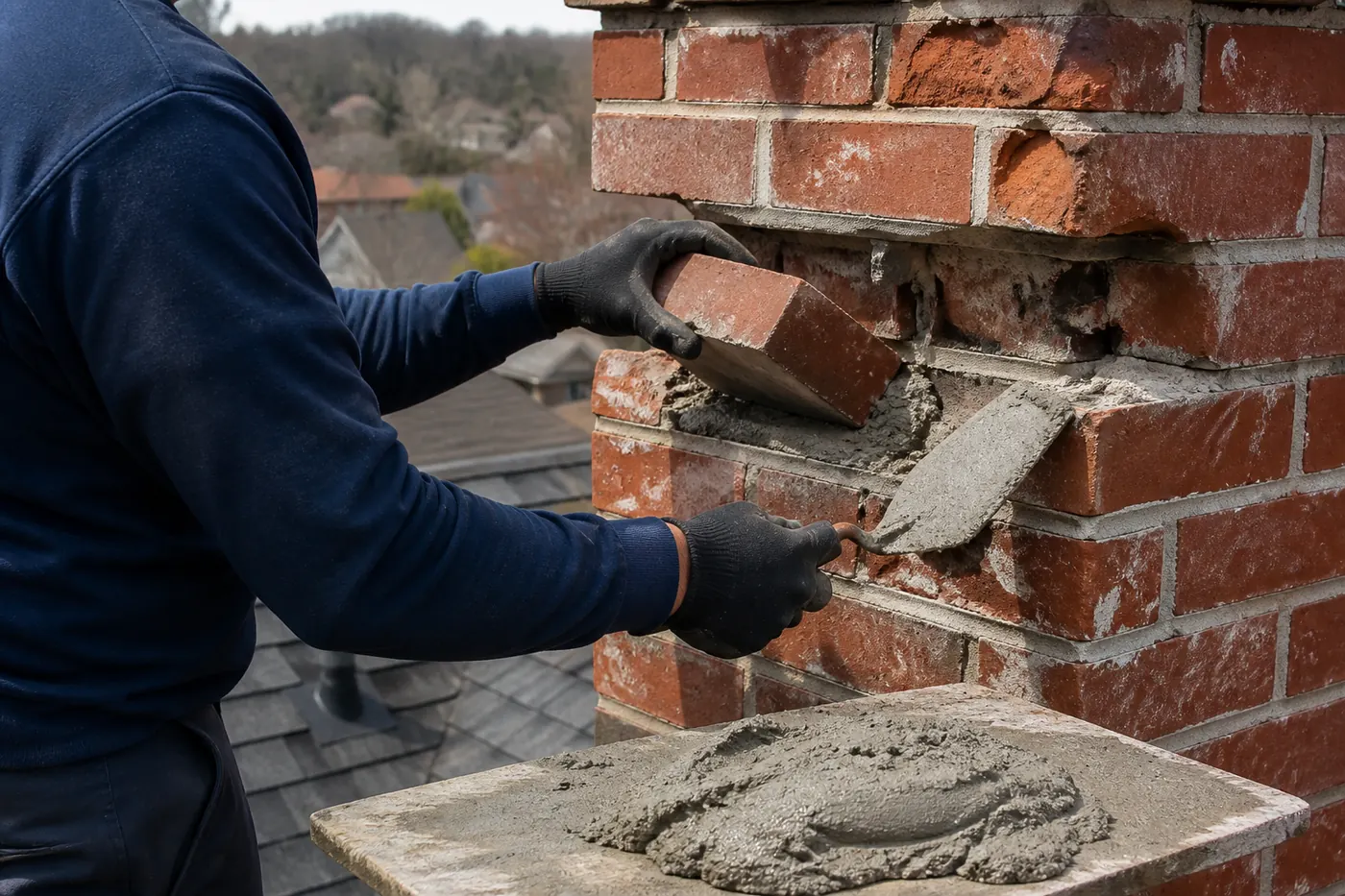
Deteriorated joints are a serious problem because they're the highway water uses to get inside the structure. Every open joint funnels moisture straight into the wall, accelerating everything else. The repair for this is chimney tuckpointing, grinding out the old, failed mortar to a consistent depth and packing in fresh mortar that restores both the weather seal and the structural bond. Repointing (a closely related term) is the same idea: replacing worn joint mortar. When only the mortar has failed but the brick is still sound, tuckpointing is the targeted, cost-effective path back to a watertight, solid chimney.
The crown is the sloped slab of masonry or concrete at the very top of the chimney, surrounding the flue. Its entire job is to shed water away from the brickwork below, like a roof for your chimney. When the crown cracks, and DFW's freeze-thaw and hail see to it that they do, water pours straight down into the structure instead of running off. A failed crown is one of the most common root causes of the interior deterioration we find.
Crown repair ranges from sealing hairline cracks with a flexible crown coating to rebuilding a crown that has broken apart entirely. A properly built crown should have an overhang (a drip edge) that throws water clear of the brick, plus the right slope to move it off quickly. Because the crown protects everything beneath it, fixing it is often the highest-value repair on the whole chimney, a relatively small job that prevents a long list of larger ones. We always inspect the crown closely, because a chimney with beautiful brickwork and a cracked crown is just water damage waiting to happen.
Once we've assessed your chimney, the repair falls into a spectrum. The lightest touch is repointing or tuckpointing, renewing failed mortar joints while keeping all the original brick. The next step up is brick replacement, where individual spalled or cracked bricks are removed and matched with new units, then set in fresh mortar. This handles localized damage without disturbing the sound masonry around it.
When deterioration has gone too far, when brick and mortar have failed together across large areas, when the structure is leaning, or when stair-step cracks show the chimney is coming apart, the answer is a partial or full chimney rebuild. In a rebuild, we take the compromised section down to a stable base and reconstruct it with new materials, correct flashing, and a properly built crown. The umbrella of masonry repair covers this whole range: tuckpointing and rebuild are the two ends of the same spectrum, and part of our job is being honest about where your chimney really falls. We won't sell you a rebuild when repointing will do, and we won't slap mortar over a chimney that has structurally failed.
After the brick and mortar are restored, waterproofing is what keeps the repair from happening all over again. This is not ordinary paint or sealer, those trap moisture inside the brick and make spalling worse. Proper chimney waterproofing uses a vapor-permeable masonry repellent that blocks liquid water from soaking in while still letting the brick breathe and release any trapped moisture as vapor. The masonry stays dry, but it doesn't suffocate.
In a freeze-thaw climate like ours, this step is genuinely preventive medicine. A quality water repellent dramatically slows the absorption cycle that drives nearly all masonry failure, extending the life of both the original brick and the new repair by years. We recommend it on virtually every masonry job because it protects the investment you just made. Fresh mortar and new brick are only as durable as their ability to stay dry through the next decade of Texas storms.
Masonry damage is progressive, and that's the crucial thing homeowners miss. Chimney problems never stay the same size, they compound. The hairline crack you can seal for a modest cost today becomes a saturated joint, then a spalled brick, then a failing course, then a leaning structure that needs a full rebuild. Each stage costs more than the last, often by a wide margin. A small crown seal is a fraction of the price of the rebuild that a neglected crown eventually forces.
There's also the collateral damage. A chimney that leaks doesn't just hurt itself, water finds its way into your attic, ceilings, and walls, rotting framing and staining drywall long before you realize the chimney is the source. And a compromised chimney can become genuinely unsafe, with loose brick, blocked flues, and structural instability. The lesson from thousands of North Texas chimneys is simple: the cheapest repair is the one you do early. Catching problems at the tuckpointing stage instead of the rebuild stage is where homeowners save the most money.
Lowes Chimney is based in Plano and serves homeowners across the entire Dallas-Fort Worth metroplex, 98 cities and counting. We know these chimneys because we work on them every week, and we understand what North Texas weather does to masonry in a way that a general contractor passing through never will. The freeze-thaw cycles, the expansive clay, the hailstorms, we've repaired the damage from all of it, in neighborhoods from Frisco to Fort Worth and everywhere between.
If you've noticed crumbling mortar, flaking brick, a cracked crown, or water stains near your fireplace, don't wait for the next storm to make it worse. A quick inspection now can save you from a major repair later. Call Lowes Chimney at (214) 225-8874 to schedule your chimney masonry repair. We're certified, insured, 5-star rated, and ready to help, often the same day, and yes, even on Sundays.
"Very pleased with the professionalism and promptness of service. The chimney sweep was done quickly and efficiently at significantly less cost than the first quote I got from another company. Happy to recommend Lowes Chimney Sweep to anyone in Plano!"
"Outstanding chimney sweep service from start to finish. They were punctual, courteous, and left our chimney spotless with no mess in our home. I won't use anyone else for chimney services in Dallas TX!"
More reviews from homeowners across the metroplex are on our reviews section, or learn more about our team before you book.
A chimney masonry repair in Dallas-Fort Worth costs $300 to $2,500 in 2026. You get a free written estimate before any work begins, and the price you’re quoted is the price you pay.
Watch for crumbling or missing mortar between bricks, flaking or chipped brick faces (spalling), brick fragments on the roof or ground, a cracked crown, white staining on the masonry, or a chimney that looks like it's leaning. Any of these means water is getting in and it's time for an inspection. Even if you're unsure, a professional look is inexpensive and can catch problems while they're still small.
They're two ends of the masonry repair spectrum. Tuckpointing renews failed mortar joints while keeping all your original brick, it's the fix when the mortar has worn out but the brick is still sound. A rebuild is for chimneys where the brick and structure itself have failed, and a section must be taken down and reconstructed. We inspect first to tell you honestly which one your chimney actually needs.
Because brick and mortar are porous, and a chimney is exposed to weather on every side with no shelter. Water soaks in, then freeze-thaw cycles expand it and crack the masonry from the inside out. Water is the number one cause of chimney deterioration, more than fire or age, which is why crown repair and waterproofing are central to lasting masonry work.
Yes. We match replacement brick as closely as possible to your existing masonry and tint mortar to blend with the original color, so repairs look consistent rather than patched. On older or unusual brick, matching takes extra effort, but our goal is always a repair that disappears into the surrounding wall.
We do. Chimney problems don't keep business hours, so we offer same-day appointments when our schedule allows and even Sunday service. Call (214) 225-8874 and we'll get you booked as quickly as possible across all 98 DFW cities we serve.
In our climate, absolutely. A vapor-permeable water repellent blocks liquid water from soaking into the brick while still letting it breathe, which dramatically slows the freeze-thaw damage that causes most masonry failure. It protects the repair you just paid for and can add years to the life of your chimney. We recommend it on nearly every job.
Straight answers from our DFW chimney pros before you book.
Get an honest ballpark range for this service, no phone call needed. Built from real Dallas-Fort Worth pricing, then book when you’re ready.
Get My Instant Estimate →