Three rail lines made the junction; the trains still stop at the old square. Every ring of growth since, postwar grids to master-planned north, gets the same standard of care.
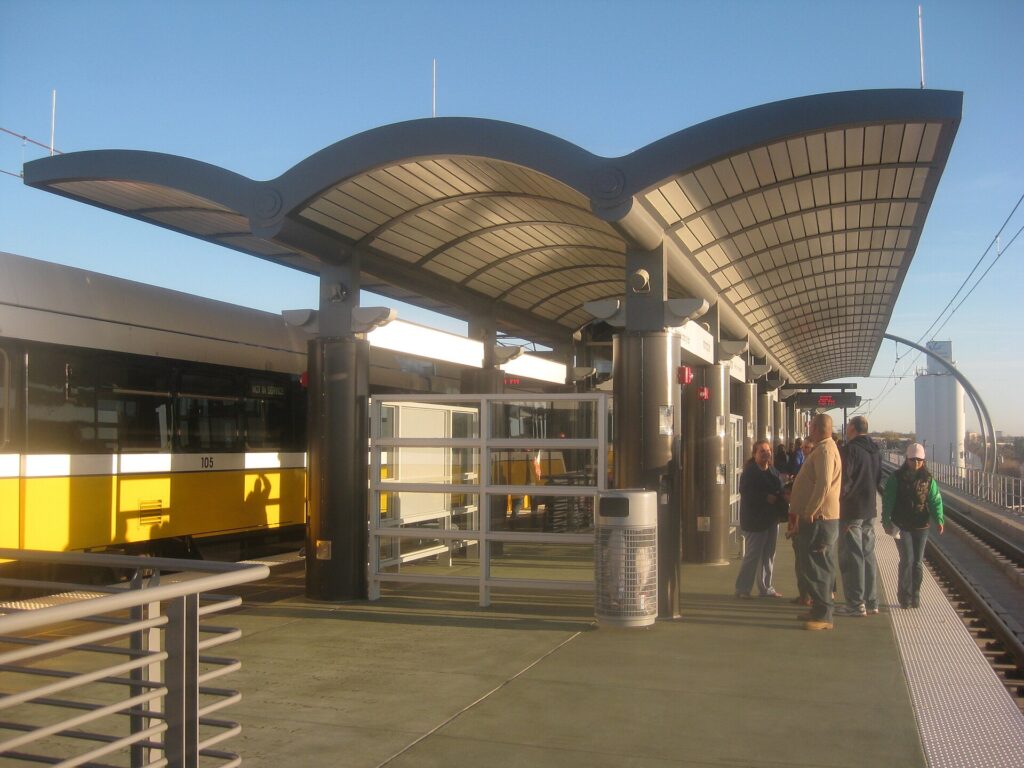
Carrollton exists because three rail lines crossed here, and the city has never stopped being a junction, the old downtown square still watches trains arrive, now carrying commuters on the A-train where freight once rolled. From that square, the city grew outward in honest rings: founding blocks, postwar grids, the great '70s-'80s two-story waves, and the master-planned north and west.
Each ring built its chimneys differently, and each ring ages on its own schedule. A Carrollton route day can start on a senior flue by the square and end on a '90s chase cover near Hebron without leaving the city, which is exactly why we read the rings before we climb the roof.
The full-ring toolkit: annual sweeps with documentation on every era, flashing repair where the heartland's forty-year seals meet two-story rooflines, tuckpointing matched into inner-ring brick, and stainless chase covers for the newer rings' metal-topped systems.
The historic downtown square blocks, where the A-train stops today, hold the founding masonry, senior flues at the center of a genuine revival. The '50s-'60s inner grids follow close behind, original-equipment chimneys at full renewal age.
The '70s-'80s heartland built the bulk of the city in two-stories whose flashing and mortar are both due their first real renewal. And the '90s-and-newer north and west toward Hebron bring the chase era, veneer-wrapped framed systems with metal covers on their own replacement clock.
Logistics: Carrollton sits just down the Bush Turnpike and Midway corridor from the Plano shop, quick tier, FAST-scheduling regularly, same-week always, seven days.
Recognize your ring? Call (214) 225-8874, we're minutes down the turnpike.
A Typical Carrollton Project
A 1979 two-story in the heartland rings, ceiling stain returning every storm season: the original flashing had been tarred twice and was failing a third time. We pulled it, cut proper step-and-counter flashing into a ground-out joint, and repointed the disturbed courses to match. Two days later, a bungalow by the old square got its pre-sale camera report for a closing file. Same city, two rings, one standard, that's the Junction City job.
Carrollton's rings all answer to the same sky: spring hail crossing the corridors most years, freeze-thaw winters working 1955 mortar and 1995 sealant with equal patience, and the clay beneath flexing every slab from the square to Hebron. What changes ring to ring is only the symptom, crowns and joints inside, flashing in the heartland, pans and veneer out north.
The standard holds across all of them: NFPA 211 calls for annual inspection of every chimney, guidance the Chimney Safety Institute of America puts in homeowner terms. On the inner rings' original flues, that yearly look carries the whole maintenance plan.
The square blocks, the founding masonry at the junction: senior flues, camera-first, revival-era paperwork. The '50s-'60s inner grids, original equipment at full renewal age. The '70s-'80s heartland, the city's biggest cohort, flashing and mortar in their renewal decade. The north and west, chase systems on the metal-cover clock.
Photos before prices, written scope before work, and the right diagnosis for your ring, no one-size-fits-all estimates in a city built in layers. The before-and-after gallery shows every ring's work; the reviews come from all of them.
Fast, Carrollton sits just down the George Bush Turnpike and Midway corridor from our Plano shop, comfortably in the quick tier. FAST-scheduling appointments happen regularly, same-week is routine, seven days a week, 8AM to 8PM with your window confirmed the day before.
Carrollton grew in rings around its old rail square, and each ring has its own file: senior mortar and crowns on the inner '50s-'60s grids, flashing and first-renewal joints across the big '70s-'80s heartland two-stories, and chase-era metal covers on the '90s-and-newer north and west. The annual rhythm is the same everywhere; the checklist changes by ring.
Because that's honestly how the city built. Three rail lines junctioned at the downtown square, the founding blocks grew around the depot, and every boom since added a ring, postwar grids, then the '70s-'80s waves, then the northern and western master-plans. Knowing your ring tells us eighty percent of what's on your roof before we ever climb it, which makes diagnosis faster and estimates more honest.
The blocks around the historic downtown square, where the rail lines still junction and the A-train now stops, hold the founding masonry, with the '50s and '60s grids just outside them close behind. Those inner rings raise Carrollton's most senior chimneys, most of them still on original crowns, caps, and clay flue tile.
It changes the paperwork. The square's revival keeps the historic inner blocks changing hands and renovating, and every sale or remodel is the moment a senior chimney either gets documented or ignored for another decade. Buyers, sellers, and renovators book camera inspections for exactly that reason, the photo report travels with the closing file or the permit set.
Because those rings built two-stories by the square mile, and two-story rooflines put more chimney-to-roof seam higher into the weather. Original flashing from that era is now forty-plus years old, tarred over once or twice and failing again. The fix that lasts is proper step-and-counter flashing cut into a ground-out mortar joint, not a third coat of roofing cement.
The same seasonal swell-and-shrink that works every North Texas foundation: inner-ring slabs drift from their masonry stacks a hairline at a time at the roofline seam, while veneer-wrapped newer construction prints stair-step cracks after dry summers. Stable hairlines are ordinary aging; widening gaps get measured, photographed, and planned.
Regularly, Carrollton rides the northwest corridors, and the aftermath follows the regional pattern: shingles replaced on insurance while chimney tops stayed off the claim. Dented caps on the inner rings and creased chase pans on the outer ones surface in our inspections constantly. Roof newer than the chimney top is the tell worth acting on.
Late summer through September beats the metroplex rush, warm months cure flashing and masonry work best, and Carrollton's spot on our quick tier means early birds routinely land next-day slots. For inner-ring original flues that have never seen a camera: before the first fire, every year.
Carrollton's routes connect two cities we already serve page-deep, Plano at our home base and Dallas down the tollway, with Lewisville, Farmers Branch and Addison, all page-deep now. Every one of the 98 DFW cities we serve is listed now.
Free online quotes · Ring-smart diagnosis · Flashing that stays fixed · Open 7 days
(214) 225-8874📍 1008 Ridgefield Dr, Plano TX 75075 | 🕗 Open 7 days · 8AM-8PM
"Very pleased with the professionalism and promptness of service. The chimney sweep was done quickly and efficiently at significantly less cost than the first quote I got from another company. Happy to recommend Lowes Chimney Sweep to anyone in Plano!"
"Outstanding chimney sweep service from start to finish. They were punctual, courteous, and left our chimney spotless with no mess in our home. I won't use anyone else for chimney services in Dallas TX!"
More reviews from homeowners across the metroplex are on our reviews section, or learn more about our team before you book.
Full-service chimney care across Carrollton and the DFW metroplex.
Helpful guides: