Lowes Chimney Sweep Blog
How Often Should You Sweep Your Chimney?
By the Lowes Chimney Sweep crew · Plano, TX
Ask ten homeowners how often a chimney needs sweeping and you will hear ten answers. Some were told once a year, no exceptions. Others burn a few fires each winter and assume they are fine indefinitely. Both can be wrong, and the difference matters, because creosote is the fuel behind most chimney fires.
The honest answer is that inspection is annual, and sweeping happens when the chimney needs it. Those are two different things, and confusing them is why some homes get swept far too often while others go dangerously long between cleanings.
Here is how to tell which one you are, what actually drives the schedule, and the warning signs that mean you should not wait for the calendar.
The short answer
Have the chimney inspected every year. Sweep it whenever the deposits justify it. For a household burning regular wood fires through a North Texas winter, that usually works out to a sweep every year or two. For a light user, it may be longer. For someone burning several nights a week, it can be more than once a season.
The inspection is what tells you which category you are actually in. Guessing is what gets people in trouble.
Why the yearly inspection is the part you should not skip
National fire safety guidance (NFPA 211) calls for chimneys, fireplaces and vents to be inspected at least once a year. The inspection covers the structure, the flue, and the connected appliance, and it checks for soundness, correct clearances, and any buildup or obstruction.
The reason it is annual regardless of use is that plenty of chimney problems have nothing to do with burning. Water gets in through a failed crown or bad flashing. Mortar joints deteriorate. Animals move in during the months the fireplace sits idle. A chimney that was never lit all year can still fail an inspection. You can read more about what a chimney inspection actually includes before you book one.
What actually drives the sweep schedule
How often you burn
This is the biggest factor. A household lighting fires most weekends from November through February builds meaningfully more deposit than one that lights the fireplace twice over the holidays. Volume of smoke through the flue is what leaves residue behind.
What you burn
Well-seasoned hardwood, dried a year or more, burns hot and relatively clean. Unseasoned or green wood is full of moisture, burns cooler, and produces far more smoke and condensable material, which is exactly what forms creosote. Softwoods and construction scrap make the problem worse. Never burn treated lumber, painted wood, or trash.
How you burn
A hot, well-supplied fire produces less deposit than a smoldering one. Damping a fire way down overnight to make it last feels efficient, but it drops flue temperature and dramatically increases what condenses on the walls. Slow, cool, smoky fires are the fastest way to coat a flue.
What the chimney serves
An open masonry fireplace, a sealed insert, a wood stove, and a gas log set all behave differently. Inserts and stoves often run longer burn cycles and can need more frequent attention. Gas appliances leave almost no creosote but still need the venting checked.
A realistic schedule by how you use your fireplace
| How you use it | Typical sweep interval | Inspection |
|---|---|---|
| A few fires a season, seasoned wood | Every 2 to 3 years, guided by inspection | Every year |
| Most weekends through winter | About every year | Every year |
| Several nights a week | Once a season, sometimes mid-season | Every year |
| Wood stove or insert as real heat | Once or twice per season | Every year |
| Gas logs or gas insert | Sweeping rarely needed | Every year |
| Unseasoned wood, or lots of slow smoldering fires | Sooner than you think, ask at inspection | Every year |
Treat this as a starting point, not a rule. The inspection is what confirms it.
Signs you should not wait for the calendar
- A strong campfire or tarry smell coming from the fireplace, especially in humid weather
- Smoke pushing back into the room instead of drawing up
- Black, flaky or shiny tar-like buildup visible in the firebox or on the damper
- Fires that are hard to start or will not stay lit
- Falling debris, or dark flakes collecting on the smoke shelf
- Scratching, chirping or fluttering sounds, which usually mean an animal or nest
- Any water in the firebox, staining on nearby walls, or rust on the damper
Several of these overlap with other problems worth ruling out. Our guide to the warning signs your chimney needs repair covers what each one usually points to.
What happens if you keep putting it off
Creosote builds in stages. Early on it is a light, flaky soot that comes off easily. Left alone through repeated seasons it hardens, then eventually becomes a glazed, tar-like layer that is genuinely difficult to remove and highly combustible. That progression is why "we will get to it next year" quietly becomes an expensive and hazardous problem.
We break the progression down in detail in creosote stages explained. The short version: the earlier it is caught, the easier and cheaper it is to deal with.
Gas fireplaces are not exempt
Gas burns cleanly, so sweeping for creosote is rarely the issue. The venting is. Birds and squirrels nest in unused flues, debris collects, and corrosion develops where moisture meets metal. A blocked vent on a gas appliance is a carbon monoxide concern, not just an efficiency one.
If your fireplace is gas, keep the annual inspection. Skip the assumption that no wood means no maintenance.
What a professional sweep actually involves
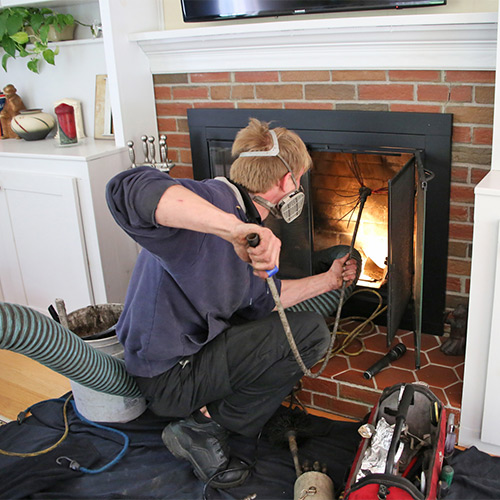
A proper sweep is not just a brush up the flue. The work area gets covered, HEPA dust control goes in place, and the flue, smoke chamber, smoke shelf and firebox all get cleaned. The technician checks the damper, cap, crown and visible masonry along the way, and shows you what was found before recommending anything. If you want the full picture, here is the anatomy of a masonry fireplace and chimney.
You should expect photos of what was found, a plain explanation of anything that needs attention, and no pressure. If a company cannot show you the problem, be careful.
North Texas has its own timing
DFW burn seasons are short and concentrated. Many homes light a handful of fires during a few cold weeks, then the chimney sits unused for eight or nine months. That long idle stretch is when animals nest, moisture works into masonry, and small cracks get bigger through heat cycling.
It also means late summer and early fall are the easiest times to book. Waiting for the first genuine cold snap puts you in line behind everyone else who did the same.
Honest Work at an Honest Number
Free online quotes · Photos before prices · HEPA dust control · Open 7 days
Call (214) 225-8874Get an Instant Estimate →📍 1008 Ridgefield Dr, Plano TX 75075 | 🕗 Open 7 days · 8AM-8PM
What it costs
Our standard single-flue chimney cleaning with a Level 1 visual inspection is a flat $299. What is right for your chimney beyond a standard sweep depends on what the inspection finds, and we explain any recommended work before it begins. For a fuller breakdown of what affects pricing, see chimney sweep cost in Dallas.
The bottom line
Put the inspection on the calendar once a year. Sweep when the evidence says to, not on a rumor. Burn seasoned wood, burn it hot, and pay attention to what the fireplace is telling you between visits.
If it has been more than a year since anyone looked at your chimney, that is the place to start. Chimney sweeping and chimney inspection are both things we handle across the Dallas-Fort Worth area.
Quick Answers
How often should a chimney be swept?
Have it inspected every year and swept whenever the inspection shows enough buildup to justify it. For most households burning regular wood fires through a North Texas winter, that works out to roughly every year or two.
Do gas fireplaces need chimney sweeping too?
Gas burns cleaner, but the venting still needs an annual look. Debris, bird nests and corrosion block flues without a single log ever being burned, and a blocked vent on a gas appliance is a carbon monoxide risk.
What happens if I skip a year of sweeping?
One light-use year rarely causes a disaster, but creosote compounds. Two or three skipped seasons is how flaky soot turns into hardened, glazed creosote that is far harder and more expensive to remove.
How do I know if my chimney needs sweeping right now?
Look for a strong campfire or tar smell, smoke pushing into the room, visible black or shiny buildup in the firebox or on the damper, or fires that will not draw properly. Any of those means get it looked at before the next fire.
Does burning less mean I never need a sweep?
Not necessarily. Light users still need the annual inspection, because water damage, animal nests and deteriorating masonry happen whether you burn or not.
What kind of wood keeps my chimney cleanest?
Well-seasoned hardwood dried a year or more. It burns hotter and leaves less deposit than green or unseasoned wood, which smolders and produces the moisture and smoke that form creosote.
When is the best time of year to schedule?
Late summer or early fall. The chimney has been idle for months, any animal or moisture problems will show up, and you are not competing for appointments during the first cold snap.
How much does a chimney sweep cost?
Our standard single-flue chimney cleaning with a Level 1 visual inspection is a flat $299. Anything beyond a standard cleaning depends on what the inspection finds, and we explain it before any work begins.
Where to go next
Ready for the service? → Professional Chimney Sweep
Keep reading: → Creosote & Chimney Fires
Did you like this article?
Your feedback helps us write better chimney guides for DFW homeowners.
Found a typo or wording we should improve? Email us and tell us exactly what to fix.