
PROTECTED WILDLIFE
Chimney Swifts in Your Chimney? Everything Homeowners Need to Know Before Removing Them
Lowes Chimney Sweep · Plano, TX · Serving 98 DFW cities
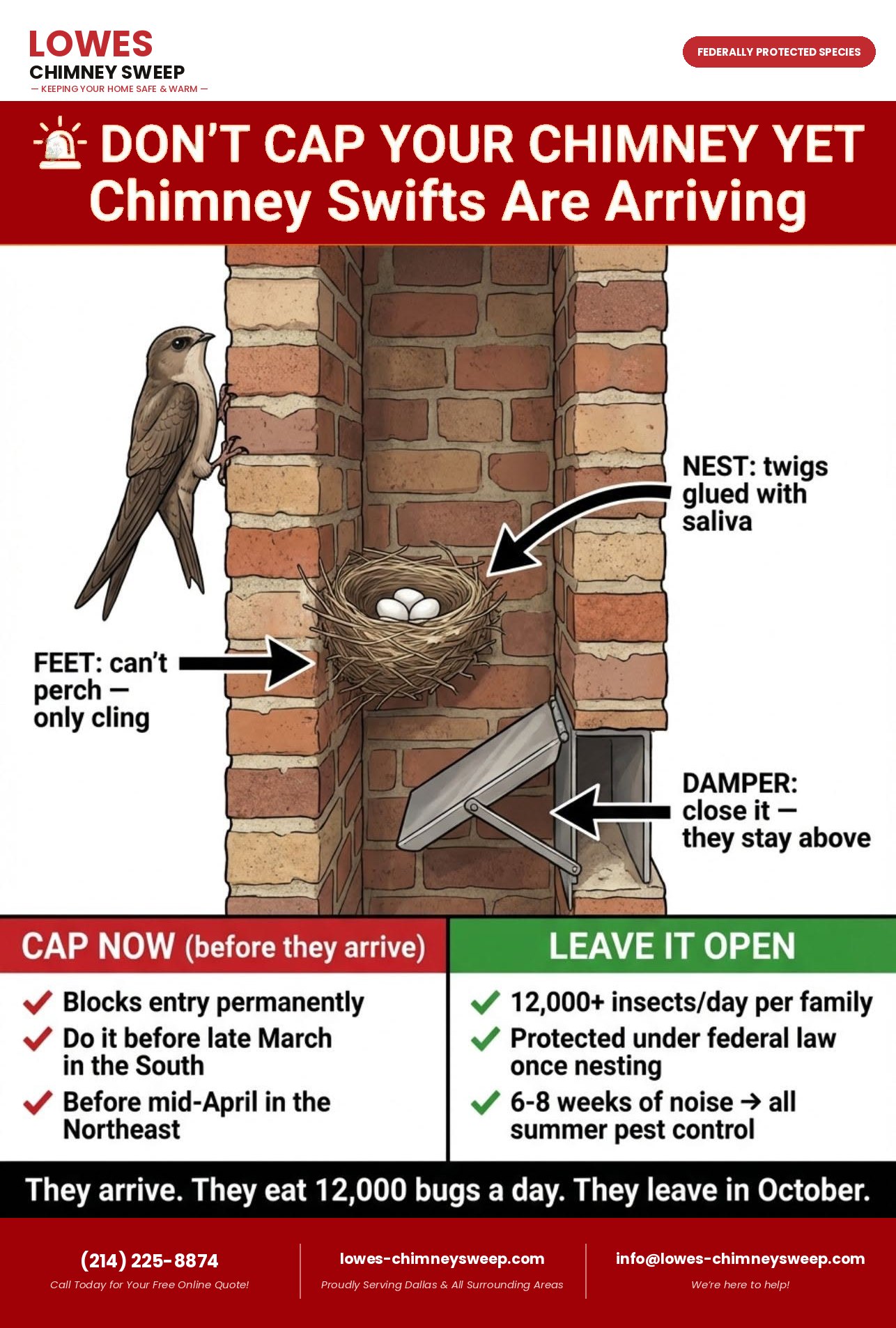
Have you started hearing chirping, fluttering, or scratching sounds coming from your chimney? If the noise begins in late spring or early summer, there's a good chance you've been visited by one of North America's most fascinating birds, the Chimney Swift.
For many homeowners, discovering birds inside a chimney is alarming. Some worry that the birds will enter the house, spread disease, or damage the fireplace. Others immediately want to remove them. However, when it comes to Chimney Swifts, the situation is unique.
Unlike squirrels, raccoons, or pigeons, Chimney Swifts are a protected migratory species. Once they begin nesting inside your chimney, federal law limits when they can legally be removed. Understanding their behavior, nesting season, and why they chose your chimney can save you time, money, and potential legal problems.
This guide explains everything homeowners should know about Chimney Swifts, including why they choose chimneys, how long they stay, when they can be removed, and, most importantly, how to prevent them from returning.
What Is a Chimney Swift?
The Chimney Swift (Chaetura pelagica) is one of the most unusual birds in North America.
Unlike most birds, Chimney Swifts spend nearly their entire lives in the air. They eat while flying, drink while flying, bathe while flying, and even collect nesting materials without landing on the ground.
Their tiny feet aren't designed for standing on tree branches like robins or sparrows. Instead, they cling to rough vertical surfaces such as brick chimneys, masonry chimneys, large hollow trees, old stone structures, and abandoned industrial chimneys.
Their stiff tail feathers act almost like a third leg, helping them brace themselves against vertical walls.
Why Did They Choose Your Chimney?
The answer is usually simple: your chimney is missing a chimney cap.
An uncapped chimney closely resembles the hollow trees where Chimney Swifts naturally nested before modern development.
To a Chimney Swift, your chimney looks like the perfect home: dark, protected from predators, warm, vertical, dry, and safe from wind.
If your chimney is open, eventually wildlife will find it.
When Do Chimney Swifts Arrive?
Their migration depends on geography. Generally, southern states see them from late March through April, the Mid-Atlantic from April through May, and northern states in May.
By late spring, they begin searching for nesting locations. If your chimney is uncapped, it may become one of their first choices.
How Do They Build a Nest?
One of the most remarkable things about Chimney Swifts is how they construct their nests.
Unlike many birds that build large nests from grass or leaves, Chimney Swifts create a small half-cup nest made from tiny twigs. Each twig is collected while the bird is flying.
The nest is then attached directly to the inside wall of the chimney using the bird's own sticky saliva, creating a surprisingly strong bond with the masonry.
Because the nest is attached to the wall rather than resting on a shelf, it can be difficult to see from the fireplace below.
Why Are They So Beneficial?
Although homeowners often worry about birds in the chimney, Chimney Swifts provide an important ecological service.
They feed almost exclusively on flying insects, including mosquitoes, gnats, flying ants, beetles, wasps, small moths, midges, and flying termites.
A single family of Chimney Swifts can consume thousands of flying insects every day, providing natural pest control throughout the summer.
For this reason, many bird enthusiasts encourage homeowners to protect Chimney Swifts whenever possible.
Why Are You Hearing So Much Noise?
The noise usually doesn't begin immediately. Adult birds are relatively quiet.
Most homeowners first notice the sounds after the eggs hatch. The young birds begin calling loudly whenever the parents return with food.
The constant chirping can sound surprisingly loud because the chimney amplifies the sound like a giant speaker.
Fortunately, this noisy stage is temporary.
How Long Do They Stay?
One of the biggest questions homeowners ask is: "When will they leave?"
Fortunately, Chimney Swifts do not stay year-round. After the eggs hatch, the young birds typically remain in the nest for approximately 45 to 55 days before becoming strong enough to fly.
Once the young leave the nest, the family eventually migrates south. In most parts of the United States, they are gone by late September or October.
The loud chirping usually lasts only a few weeks during the peak feeding period before gradually stopping as the young mature.
Are Chimney Swifts Protected?
Yes. Chimney Swifts are protected under the Migratory Bird Treaty Act (MBTA).
This federal law makes it illegal to disturb or remove an active nest containing eggs or young birds. Attempting to remove the birds during nesting season can harm the birds and may violate federal regulations.
For that reason, timing is extremely important.
Can Chimney Swifts Be Removed?
It depends.
Before They Nest: If birds are only investigating the chimney and have not built a nest, installing a properly fitted chimney cap may prevent them from moving in.
During Active Nesting: Once eggs or young birds are present, removal should generally wait until the birds naturally leave the chimney.
After They Leave: Once the birds have migrated, the chimney can safely be inspected, cleaned, and capped to prevent future nesting.
Signs You May Have Chimney Swifts
Common signs include rapid chirping inside the chimney, sounds that increase during daylight, birds flying quickly around the chimney at dusk, birds entering and exiting the chimney opening, small twigs inside the fireplace, and noises beginning in late spring or early summer.
These signs usually indicate nesting activity.
Why a Chimney Cap Is So Important
A chimney cap is one of the simplest and most effective ways to protect your chimney.
A properly installed cap helps prevent birds, squirrels, raccoons, bats, leaves, rainwater, and debris.
Without a cap, your chimney becomes an open invitation for wildlife.
Installing a quality stainless steel chimney cap after nesting season is the best long-term solution.
What Should You Do If You Already Have Chimney Swifts?
If you suspect Chimney Swifts are nesting inside your chimney: do not light a fire; keep the fireplace damper closed if it is below the nesting area; listen for activity to determine whether the birds are still present; contact a professional chimney company for an inspection; and wait until the birds have naturally left before scheduling removal of nesting material and installation of a chimney cap.
Patience now helps protect both the birds and your chimney.
How to Prevent Them From Returning Next Year
Once the nesting season is over: remove any remaining nesting material, inspect the flue for damage, clean the chimney, install a professionally fitted chimney cap, and repair damaged masonry or chimney crowns if needed.
These simple steps greatly reduce the chances of wildlife returning in future seasons.
Honest Work at an Honest Number
Free online quotes · Photos before prices · HEPA dust control · Open 7 days
Call (214) 225-8874Get an Instant Estimate →📍 1008 Ridgefield Dr, Plano TX 75075 | 🕗 Open 7 days · 8AM-8PM
Related Reading
Animal Removal Services · Chimney Cap Installation
If Chimney Swifts have chosen your chimney, it's a sign that your chimney is missing one of its most important protective components, a properly installed chimney cap.
While these birds provide valuable natural insect control and deserve protection during nesting season, an uncapped chimney also leaves your home vulnerable to rain, moisture, squirrels, raccoons, bats, and other unwanted wildlife.
Once the birds have safely migrated, schedule a professional chimney inspection. We can remove nesting debris, inspect the flue, recommend any necessary repairs, and install a durable chimney cap that protects your home for years to come.
Quick Answers
Will Chimney Swifts come into my house?
Normally, no. They remain inside the flue above the fireplace and do not enter the living space when the fireplace and damper are intact.
Can I use my fireplace while they are nesting?
No. Never use a fireplace while birds are nesting inside the chimney.
How long will the baby birds stay?
Most young Chimney Swifts leave the nest approximately 45 to 55 days after hatching, although the exact timing can vary depending on weather and food availability.
Will they return every year?
They often return to successful nesting locations if the chimney remains uncapped.
What's the best way to keep birds out permanently?
Installing a professionally fitted chimney cap after the nesting season is the most effective long-term solution.
Where to go next
Ready for the service? → Chimney Nest Removal
Keep reading: → Animal in Your Chimney? What to Do
Did you like this article?
Your feedback helps us write better chimney guides for DFW homeowners.
Found a typo or wording we should improve? Email us and tell us exactly what to fix.