Lowes Chimney Sweep Blog
How Can You Tell If Your Chimney Bricks Are Spalling?
By the Lowes Chimney Sweep crew · Plano, TX
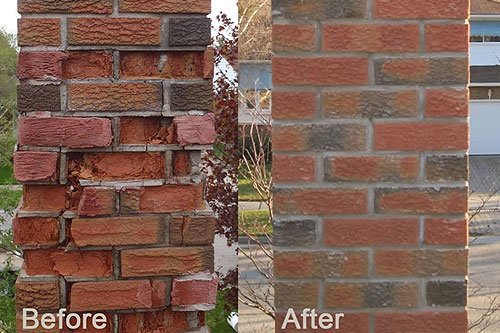
The telltale signs of spalling are chips and flakes of brick face collecting at the base of the chimney or in your gutters, pitted or peeled brick surfaces, and patches of rough orange core showing where the smooth face used to be. Spalling means the brick itself is breaking apart, different from whole bricks coming loose, which is a mortar problem. It is also progressive: once a brick loses its face, it deteriorates faster every season. Catching it at the first flakes is what keeps this a repair instead of a rebuild.
How Spalling Happens
Brick comes out of the kiln with a hard, fired outer face protecting a softer, more porous core. Spalling starts when water soaks into that brick and then freezes, the ice expands and pops the face right off. Salt crystallization does the same job in slow motion: dissolved salts migrate toward the surface, crystallize just behind the face, and push it off from the inside. Either way, the protective face is gone and the soft core is exposed to the weather.
That exposed core is why spalling accelerates once it starts. The core absorbs water far faster than the fired face ever did, so each freeze does more damage than the last. A chimney that shed a few flakes last winter can lose whole brick faces the next. Spalling is not a cosmetic issue that stays put, it is a water problem with momentum.
The Early Signs, Seen From the Ground
Chips and flakes at the base. Thin shards of brick face, often smooth on one side, rough on the other, collecting at the chimney base, in flower beds, or washing out of the gutters are usually the first evidence.
Pitted or peeled brick faces. Scan the stack with binoculars. Bricks that look pockmarked, blistered, or as if a layer has been peeled away have already lost part of their face.
Rough orange patches. An exposed core is usually brighter and rougher than the surrounding fired faces. Those patches are the bricks now absorbing water the fastest.
Brick dust. Gritty red-orange dust on the roof, in the gutters, or at the base means brick is actively breaking down.
What You Can Safely Check
Everything above can be checked with your feet on the ground. Walk the chimney's base after a rain and look for fresh fragments, check the downspout splash zone for brick grit, and use binoculars on the upper courses, spalling concentrated near the top usually points at the crown. Glance inside the firebox too, since flaking on the firebox walls is worth noting. What is not a homeowner job: climbing onto the roof, picking at damaged bricks, or coating the chimney with a general-purpose sealer, the wrong sealer traps moisture inside the brick and makes freeze-thaw damage worse. Just note where the damage is concentrated; that pattern is half the diagnosis.
When Spalling Becomes Urgent
A few flaked faces low on the stack is a schedule-the-repair problem, not an emergency. It becomes urgent when the damage goes deep: bricks losing material through multiple faces, spalling concentrated near the crown where the structure takes the most water, or any visible lean or a gap opening between the chimney and the house. And if you can see spalled or flaking surfaces inside the firebox, stop using the fireplace until the structure and flue have been assessed, masonry deteriorating that close to the flue is a containment question, not just a cosmetic one.
How a Professional Repairs Spalling
The brick work itself is straightforward: spalled bricks are cut out and replaced with matched brick and mortar, and our chimney masonry repair visits start by probing how deep the damage runs rather than just swapping the faces you can see. The part that separates a lasting repair from a repeat visit is this: replacing spalled brick without fixing the water source means the new brick spalls too. So the same visit traces where the water is getting in, most often a cracked crown, which is what chimney crown repair solves, a missing or undersized cap, or bare masonry that needs a breathable water repellent. Fix the water first, then the brick, and the repair holds.
Honest Work at an Honest Number
Free online quotes · Photos before prices · HEPA dust control · Open 7 days
Call (214) 225-8874Get an Instant Estimate →📍 1008 Ridgefield Dr, Plano TX 75075 | 🕗 Open 7 days · 8AM-8PM
The DFW Factor
North Texas is spalling country because our freezes are not gentle. A 70-degree afternoon can drop below freezing overnight, and that rapid swing, brick soaked by a warm rain, then frozen hard a few hours later, is exactly the cycle that pops brick faces. Add the long wet springs that keep unsealed masonry saturated for weeks, and a DFW chimney can take more damaging freeze-thaw hits in one winter than it would in a colder but steadier climate. If your chimney is shedding flakes now, late summer is the time to fix it, before the first cold front turns wet brick into broken brick.
Finding flakes of brick at the base of your chimney? Tell us what you are seeing, or send a photo, and request a Free Online Quote, or call (214) 225-8874. We will find where the water is getting in and fix that first, so the repaired brick stays repaired.
Quick Answers
Can I stop spalling by sealing the chimney myself?
Not with a typical off-the-shelf sealer, many form a film that traps moisture inside the brick, which accelerates freeze-thaw damage. Already-spalled brick needs replacement first, and the right product afterward is a breathable water repellent applied to sound masonry.
How much does spalling brick repair cost?
It scales directly with how far the damage has spread. Caught early, it is a modest repair, a handful of bricks plus fixing the water source, while widespread, deep spalling can approach a partial rebuild, which is the strongest argument for acting on the first flakes.
Does spalling mean my chimney has to be rebuilt?
Usually not. If it is caught while the damage is shallow and localized, replacing the affected bricks and correcting the water entry stops the process; rebuilds become necessary only when spalling has run deep through large sections of the stack.
Where to go next
Ready for the service? → Chimney Masonry Repair
Keep reading: → Tuckpoint or Rebuild?
Did you like this article?
Your feedback helps us write better chimney guides for DFW homeowners.
Found a typo or wording we should improve? Email us and tell us exactly what to fix.