● Pricing reviewed & current for October 2026
A chimney leak almost never starts where the stain appears. Water travels. We find the real entry point before anyone touches a tube of sealant.
Quick answer: A chimney leak repair in Dallas-Fort Worth costs $400 to $3,000 in 2026, with a free written quote before any work begins.
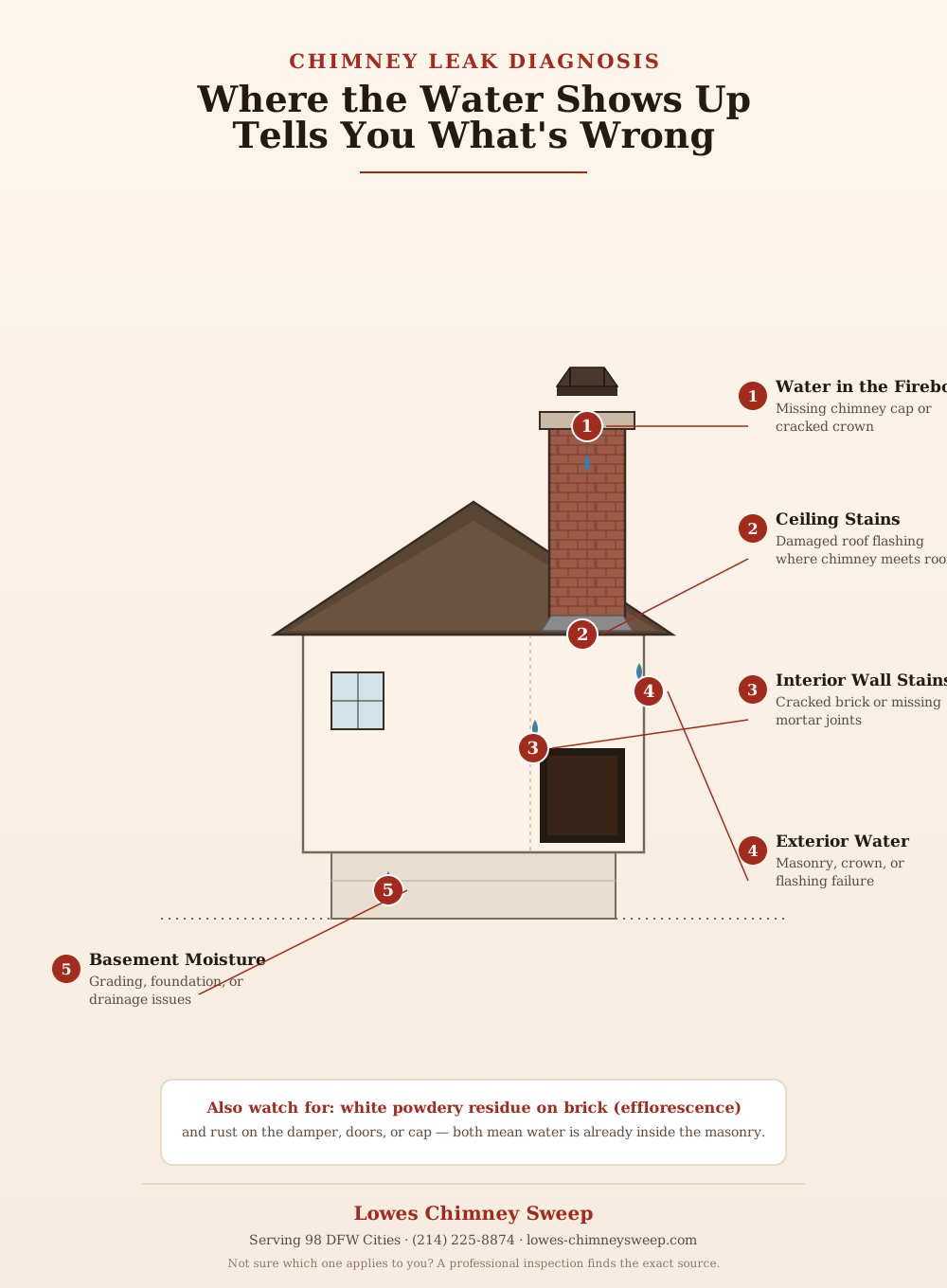
This is the single most important thing to understand about a chimney leak, and it is why so many of them get "fixed" twice. Water enters at the top of a chimney, runs down inside the structure, and emerges wherever it finds a path, which can be several feet away and one floor down. The brown ring on your ceiling is where the water gave up, not where it got in.
That is why we do not start with a caulk gun. We start on the roof, and we work out which of the five usual suspects is responsible before we quote anything. Sealing the wrong thing is how a homeowner ends up paying twice and still having a leak next spring.
The concrete slab on top. It is supposed to shed water away from the flue and it cracks with age, and once it cracks water pours straight into the chimney structure. This is the most common source we find, and it is why crown repair is one of our busiest services.
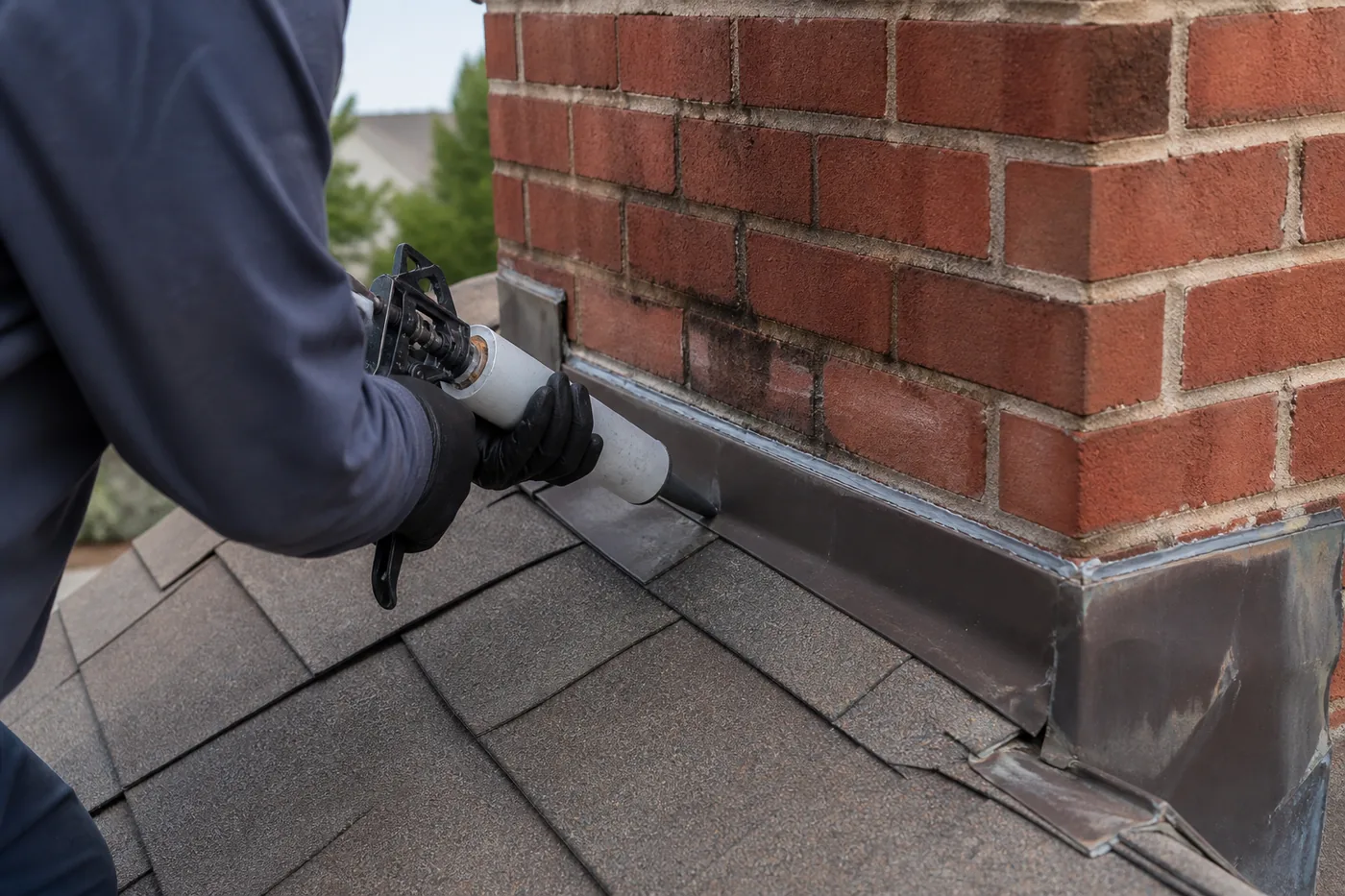
The metal seal where the chimney meets the roof. When flashing fails, water runs between the chimney and the roof deck, which is why leaks from flashing usually show up as a stain on the ceiling near the chimney rather than inside the firebox. Flashing repair is the fix.
A chimney without a cap is an open pipe pointed at the sky. Every inch of Texas rain goes straight down it. A chimney cap is the cheapest fix on this list and it prevents the most expensive problems.
Brick is porous, and old mortar joints are more porous still. Water soaks in, freezes on those handful of North Texas nights below freezing, expands, and spalls the face off the brick. Tuckpointing restores the joints, and waterproofing keeps them from doing it again.
On a prefab chimney, the metal lid on top rusts. Rusted chase covers pond water and eventually perforate, and then the water goes directly into the chase. Chase cover replacement handles it.
The musty smell is the one people ignore longest, because it is easy to blame on an old fireplace. It is usually water.
We go on the roof. We look at the crown, the cap, the flashing, the mortar joints, and the chase cover, and we photograph all of it. If the source is not obvious from inspection, we water-test: isolate one area, run water on it, and see what happens inside. It is unglamorous and it is the only way to be certain.
Then you get shown the photos and told exactly what is letting water in, what it will take to stop it, and what the water has already damaged. If it is a cracked crown and a rusted cap, we say so. If it is only a missing cap and the rest of the chimney is sound, we say that too, and that is a much smaller bill than most people are braced for.
Sometimes, and sometimes sealing is the worst thing you could do. Waterproofing a chimney that already has water inside the masonry traps it there. The sequence matters: find the source, fix the source, dry it out, then waterproof.
It depends entirely on which of the five sources is responsible, and they range from an inexpensive cap installation to a full crown rebuild. That is exactly why we diagnose before we quote. We give you a real number after we know what is wrong, and the number does not change afterwards.
Water damage is one of the few chimney problems that compounds fast. Water gets in, freezes, spalls brick, rusts the damper, rots the framing behind the wall. A leak that costs a few hundred to stop this season becomes a rebuild in three.
A chimney company. Roofers seal flashing, which is one of five possible sources, and it is the one they will find because it is the one they look for. If the crown is the problem, new flashing will not help you.
Water in a chimney does not sit still. It rusts the damper until it will not close. It saturates the masonry, and when North Texas does get a freeze, that water expands and takes the face off the brick. It rots the wood framing where the chimney passes through the house, which is a structural repair, not a chimney repair. And it destroys the liner, which is a safety failure, because a compromised liner lets combustion gases into the house.
The Chimney Safety Institute of America identifies water as the single greatest cause of chimney deterioration, ahead of fire. The National Fire Protection Association recommends an annual inspection precisely so problems like this are found while they are still cheap.
"Very pleased with the professionalism and promptness of service. The chimney sweep was done quickly and efficiently at significantly less cost than the first quote I got from another company. Happy to recommend Lowes Chimney Sweep to anyone in Plano!"
"Outstanding chimney sweep service from start to finish. They were punctual, courteous, and left our chimney spotless with no mess in our home. I won't use anyone else for chimney services in Dallas TX!"
More reviews from homeowners across the metroplex are on our reviews section, or learn more about our team before you book.
Water is getting in through one of five places: a cracked crown, failed flashing, a missing or damaged cap, porous brick and mortar, or a rusted chase cover. The stain inside your house is rarely under the actual entry point, because water travels down inside the structure before it emerges. Diagnosis comes before repair.
We inspect the crown, cap, flashing, mortar joints, and chase cover from the roof and photograph everything. If the source is not obvious, we water-test, isolating one area at a time and running water on it to see what appears inside. Guessing and sealing is how leaks get fixed twice.
It depends which of the five sources is responsible. A missing cap is one of the cheapest fixes we do. A failed crown or extensive spalled brickwork costs considerably more. We diagnose first, quote a real number, and that number does not change once we start.
Not before you know where the water is entering, and not if water is already inside the masonry. Waterproofing a wet chimney seals the moisture in, which accelerates the damage instead of stopping it. Find the source, fix it, let it dry, then waterproof.
Efflorescence. It is mineral salt left behind when water moves through masonry and evaporates on the surface. It is not the problem itself, it is proof of the problem: water is actively traveling through your brick.
That is usually water, not age. Moisture in the flue and firebox combines with soot and creosote residue and produces the smell, and it is at its worst on humid days. If the smell tracks with the weather, you have water getting in somewhere.
A chimney company. Roofers know flashing, and flashing is only one of five possible sources. If your crown is cracked or your cap is gone, new flashing will not stop the leak, and you will have paid for work that did not fix your problem.
More urgent than most people assume. Water rusts the damper, spalls the brick, rots the framing behind the chimney, and destroys the liner, and a compromised liner is a safety issue, not just a repair bill. Leaks are the one chimney problem that reliably gets more expensive the longer it waits.
We serve 98 cities across the Dallas Fort Worth metroplex, seven days a week from 8 AM to 8 PM. Check our service areas or call and we will confirm we cover you before scheduling.
A chimney leak is diagnosed, not guessed at, and the fix depends on the source. Most often it is chimney crown repair or flashing repair. Sometimes it is as simple as installing a chimney cap, or replacing a rusted chase cover. When water has already worked into the masonry, tuckpointing restores the joints, and in severe cases a chimney rebuild is the honest answer. Start with a chimney inspection if you are not sure what you are dealing with, see documented repairs on our before and after gallery, or read our guide on why chimneys leak.
We diagnose the source, show you the photos, and quote the real fix. Seven days a week across 98 DFW cities.
Call (214) 225-8874Water entering a cracked crown runs down the outside of the flue liner, inside the chimney structure, until it hits something that stops it, usually the point where the chimney passes through the roof or the ceiling. That is where it exits and stains. The distance between where it entered and where you see it can easily be ten feet. This is why chasing the stain never works.
Crowns crack because they were poured too thin, without an overhang, and without expansion room around the flue. A crack sealer buys you a season or two. A properly built crown with a drip edge that throws water clear of the brick is what actually solves it. We will tell you honestly which one your chimney needs.
People assume spalling brick is a northern problem. It is not. North Texas gets enough nights below freezing to do the damage, and the mechanism only needs the brick to be saturated when the temperature drops. A chimney that stays wet all winter will spall here just as reliably as one in Ohio, only slower.
Two sources can produce identical stains. A homeowner replaces the flashing, the leak continues, and now they distrust the whole trade. Isolating each area with water and watching what happens inside takes an extra thirty minutes and it removes all doubt. It is the difference between a repair and a gamble.
A chimney cap is inexpensive, takes an hour, and it stops rain, animals, and debris from going down an open flue. Almost every catastrophic water problem we see in a prefab chimney traces back to a missing or failed cap. If you do one preventive thing to your chimney, it is this.
Masonry waterproofing products are vapor-permeable for a reason: brick has to breathe. But if you seal a chimney that is already holding water, you have trapped it. The order is diagnose, repair, dry, then waterproof. A company that leads with waterproofing before finding the leak is selling you a product, not a solution.
Straight answers from our DFW chimney pros before you book.
Get an honest ballpark range for this service, no phone call needed. Built from real Dallas-Fort Worth pricing, then book when you’re ready.
Get My Instant Estimate →