Lowes Chimney Sweep Blog
Chimney Repair Cost in Fort Worth 2026
By the Lowes Chimney Sweep crew · Fort Worth & Tarrant County, TX
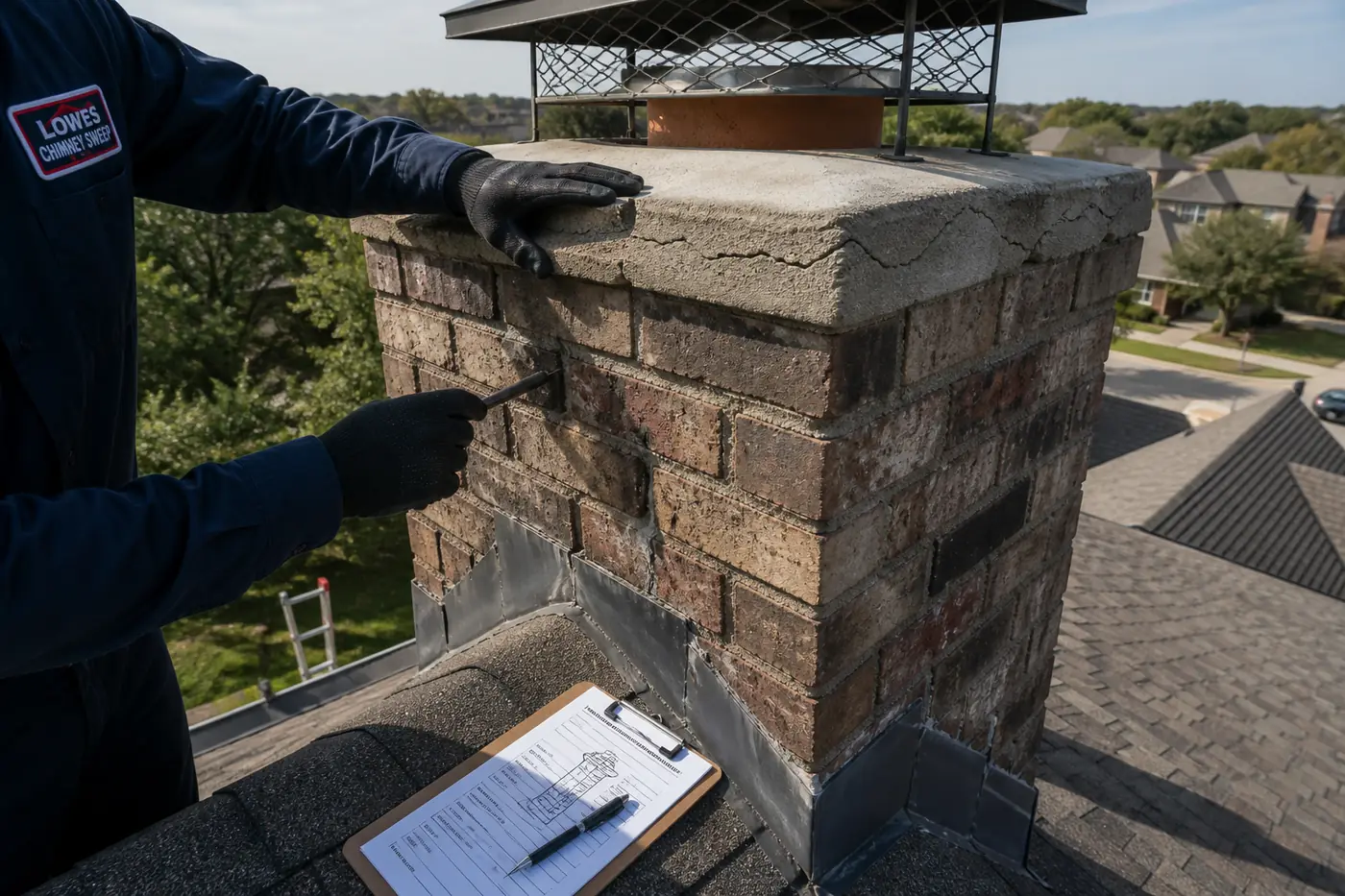
The short answer: a chimney repair in Fort Worth costs $300 to $2,500 in 2026, minor crown sealing, cap replacement, and small flashing fixes sit at the low end, while crown rebuilds, tuckpointing, and partial masonry rebuilding reach the high end. This is a planning range for budgeting; the final price follows a free on-site inspection with photographs and a written scope, because a service name alone cannot reveal concealed damage or the true extent of the work.
- Chimney repair in Fort Worth: $300 to $2,500 depending on component and extent
- Low end: crown sealing, cap replacement, small flashing fixes
- High end: crown rebuilds, tuckpointing, partial masonry rebuilding
- North Texas hail, wind, and expansive clay soil drive most repairs
- Final repair price: after a free on-site inspection with photos and a written scope
- Storm damage is not automatically covered, document it and contact your insurer
How much does a chimney repair cost in Fort Worth in 2026?
| Repair | Typical planning range |
|---|---|
| Chimney cap replacement | $300 to $650 |
| Crown sealing or repair | $350 to $900 |
| Flashing repair or chase-cover replacement | $400 to $1,200 |
| Tuckpointing / mortar-joint repair | $600 to $1,800 |
| Crown rebuild / partial masonry rebuild | $1,200 to $2,500+ |
| Final repair price | After a free on-site inspection |
Two homes with the "same" repair rarely pay the same amount. A cap replacement on a single-flue ranch near TCU is a short job; the same nominal repair on a tall two-story Fairmount chimney with fragile historic roofing takes longer and needs more protection. The range above is a budgeting tool. The firm number comes from the inspection, where the component, quantity, access, and condition are actually confirmed.
What affects chimney repair cost in Fort Worth?
Component: A cap or a small flashing patch is a different job from a crown rebuild or masonry reconstruction. Quantity: Count courses, joints, panels, penetrations, and flues, repairing two joints is not the same as tuckpointing an entire stack. Condition: Separate routine wear from corrosion, displacement, missing material, or damage that extends behind the visible surface. Access: Roof pitch, chimney height, fragile or hail-battered roofing, tight historic lots in the Near Southside, and whether staging is needed all change labor. Material: Matching historic brick and mortar in Fairmount or Ryan Place costs more than a modern cap. Coordination: Roofing, gas, historic review, permits, or insurance documentation may add a separate responsibility.
A good estimate ties each applicable factor to a price rather than hiding all of them inside a generic "labor and materials" line. If a condition cannot be confirmed until limited removal or cleaning occurs, the proposal should identify that uncertainty and explain how approval for any additional work will be handled.
What's included in a Fort Worth chimney repair?
A complete repair covers more than the new material. For a crown rebuild, for example, the scope should include removing the failed crown, preparing the masonry, forming and pouring or casting the new crown with a proper overhang and drip edge, sealing, protecting the roof and interior, and cleaning up debris. For flashing, it should specify whether the step and counter-flashing are being replaced or merely resealed, and how the tie-in to the roof is handled. Cap and chase-cover work should state the material and gauge and whether existing rust is being addressed.
The proposal should also state what is excluded, so a homeowner is not surprised later. Naming the component precisely, sealing versus partial repair versus replacement versus rebuilding, matters because each keeps or removes a different amount of existing work, and each changes preparation, material, labor, cure time, and the conditions that could affect the final price.
Why repairs matter specifically in Fort Worth
Tarrant County's humid subtropical climate is unusually hard on chimneys, and it drives the repair mix. The National Weather Service reports that severe weather across the DFW Metroplex peaks in spring, with large hail and damaging winds occurring somewhere in the region nearly every year. Fort Worth's position on the western edge of the Metroplex places it squarely in that hail corridor, so cap, crown, and flashing damage from hail and wind is the single most common repair driver here. Once hail cracks a crown or lifts flashing, water enters the masonry, and North Texas freeze-thaw cycles then widen every crack over the winter.
The ground matters as much as the sky. Much of Tarrant County sits on expansive Blackland Prairie clay that swells when wet and shrinks in the summer drought. That seasonal movement can crack a crown, separate the chimney from the house at the flashing line, and open mortar joints, which is why tuckpointing and crown work are staples of Fort Worth chimney repair. Neighborhood and building age shape the job too: the soft, century-old brick in the Fairmount National Historic District and Ryan Place needs compatible mortar and careful matching, while factory-built fireplace chases in newer subdivisions in Keller, Saginaw, and north Fort Worth more often need chase-cover and cap work than true masonry repair.
Repair or rebuild, how to tell the difference
A full or partial rebuild is warranted when masonry has failed structurally over a large area, leaning, widespread spalling, or crumbling that targeted patching cannot stabilize. Targeted repairs such as tuckpointing, crown sealing, or replacing a single section apply when sound material remains and only specific components have failed. The honest way to decide is a free on-site inspection with photographs that shows the condition and names, in plain terms, what will stay and what will be removed.
Be wary of a quote that jumps straight to "rebuild the chimney" without showing why targeted repair won't do, and equally wary of a cheap patch over a structural problem that will return in a season. The difference is not opinion, it is visible in the masonry, and a good estimator will point to it.
Storm damage and insurance
Because hail and wind cause so many Fort Worth chimney repairs, insurance questions come up often. A storm does not automatically mean the insurer will pay. The practical steps: document the event and the damage with dated photographs, prevent additional loss when it is safe to do so, for example, temporarily covering an opened chase, and contact your insurer promptly. Coverage and claim decisions belong to the insurer and the policy, not the contractor. A useful inspection report supports a claim by connecting the specific damage to the event with clear overview and close-up photographs.
Why the price is not the whole decision
Lowes Chimney Sweep uses published planning ranges to help Fort Worth homeowners budget before an appointment. The final price follows a free on-site inspection because a service title cannot reveal quantity, access, material, system type, or concealed conditions. If the scope changes once work is underway, the technician should show the condition, explain the boundary, and obtain approval before doing additional work.
Compare two repair estimates only after confirming that both include the same work. One proposal may retain sound material while another removes it; one may include staging, roof protection, debris disposal, and completion photographs while another lists only a service name. The lowest total is not the same value when the scope is smaller or undefined.
Historic Fort Worth and permits
Exterior repair on a designated Fort Worth Historic and Cultural Landmark, or on a property inside a local historic district such as Fairmount, Ryan Place, Elizabeth Boulevard, or Grand Avenue, may require a Certificate of Appropriateness from the Historic and Cultural Landmarks Commission before work begins. Owners in those protected areas should confirm requirements for the address and the proposed scope before authorizing masonry repair, crown work, or a visible cap change.
Historic masonry also demands material judgment. Older brick is often softer than modern units, and a hard, incompatible mortar can transfer stress into the brick faces and cause new damage. Matching color is not enough; the repair should consider strength, vapor movement, joint profile, tooling, and cleaning method so the fix protects the original masonry rather than accelerating its failure.
Safety boundaries
Do not climb a steep, wet, storm-damaged, or unfamiliar roof to assess or attempt a repair. Stop using a fireplace or appliance when smoke enters occupied space, alarms activate, gas odor is present, venting is visibly damaged, or masonry is falling. For a suspected chimney or building fire, leave the home, call 911 from a safe location, and remain outside until firefighters say it is safe. Gas components, listed factory-built fireplaces, liners, and venting systems require compatible parts and qualified work; a photograph cannot establish that a repaired system is safe to operate.
How to prepare for the appointment
Record when the symptom started and any storm dates, and collect prior reports, invoices, permits, and photographs. Clear reasonable access to the fireplace and the exterior base of the chimney, keep children and pets away from the work area, and do not disassemble anything before the technician arrives. If you have opened an insurance claim, have the claim number ready.
Four questions worth asking before you approve: What exact component failed? What evidence shows it? What sound material will remain? What could legitimately change the price? Keep the written answers and completion photographs with the home's records.
Schedule service in Fort Worth
Lowes Chimney Sweep serves Fort Worth, Arlington, Keller, Southlake, Colleyville, Grapevine, Mansfield, Benbrook, and communities across Tarrant County and the wider Metroplex. Call (214) 225-8874 or use the online quote form. Describe the symptom and any storm dates; final repair pricing follows the free on-site inspection.
Frequently asked questions
How much does a chimney repair cost in Fort Worth?
A chimney repair in Fort Worth costs $300 to $2,500 in 2026, depending on the component and extent. Minor crown sealing, cap replacement, and small flashing fixes sit at the low end; crown rebuilds, tuckpointing, and partial masonry rebuilding reach the high end. The final price follows a free on-site inspection.
Is the $300 to $2,500 range a guaranteed quote?
No. It is a planning range. Final repair pricing follows a free on-site inspection of the component, quantity, access, material, and condition, because a service title alone cannot reveal concealed damage or the true extent of the work.
What are the most common chimney repairs in Fort Worth?
In Tarrant County the most common repairs are crown sealing and rebuilds, flashing and chase-cover fixes after hail and wind, cap replacement, tuckpointing of failed mortar joints, and waterproofing, largely driven by North Texas hail, wind, and expansive clay soil.
Does insurance cover chimney repair after a storm?
Not automatically. Document the event and the damage, prevent additional loss when it is safe to do so, and contact your insurer. Coverage and claim decisions belong to the insurer and the policy, not the contractor.
How can I tell if I need a repair or a full rebuild?
A rebuild is warranted when masonry has failed structurally over a large area; targeted repairs such as tuckpointing or crown work apply when sound material remains. A free on-site inspection with photographs should show the condition and name what stays versus what is removed.
Can I send photos to get a repair estimate first?
Photos can help route the request, but they may not show depth, hidden damage, safe access, or adjacent failures. A firm repair price follows a free on-site inspection.
How do I schedule a chimney repair in Fort Worth?
Call (214) 225-8874 or use the Lowes Chimney Sweep online quote form.
Honest Work at an Honest Number
Free online quotes · Photos before prices · HEPA dust control · Open 7 days
Call (214) 225-8874Get an Instant Estimate →📍 1008 Ridgefield Dr, Plano TX 75075 | 🕗 Open 7 days · 8AM-8PM
Did you like this article?
Your feedback helps us write better chimney guides for DFW homeowners.
Found a typo or wording we should improve? Email us and tell us exactly what to fix.