● Pricing reviewed & current for October 2026
There is a point where sealing old flashing is just delaying the bill. When the metal is gone, the fix is new metal, cut into the mortar the way it should have been the first time.
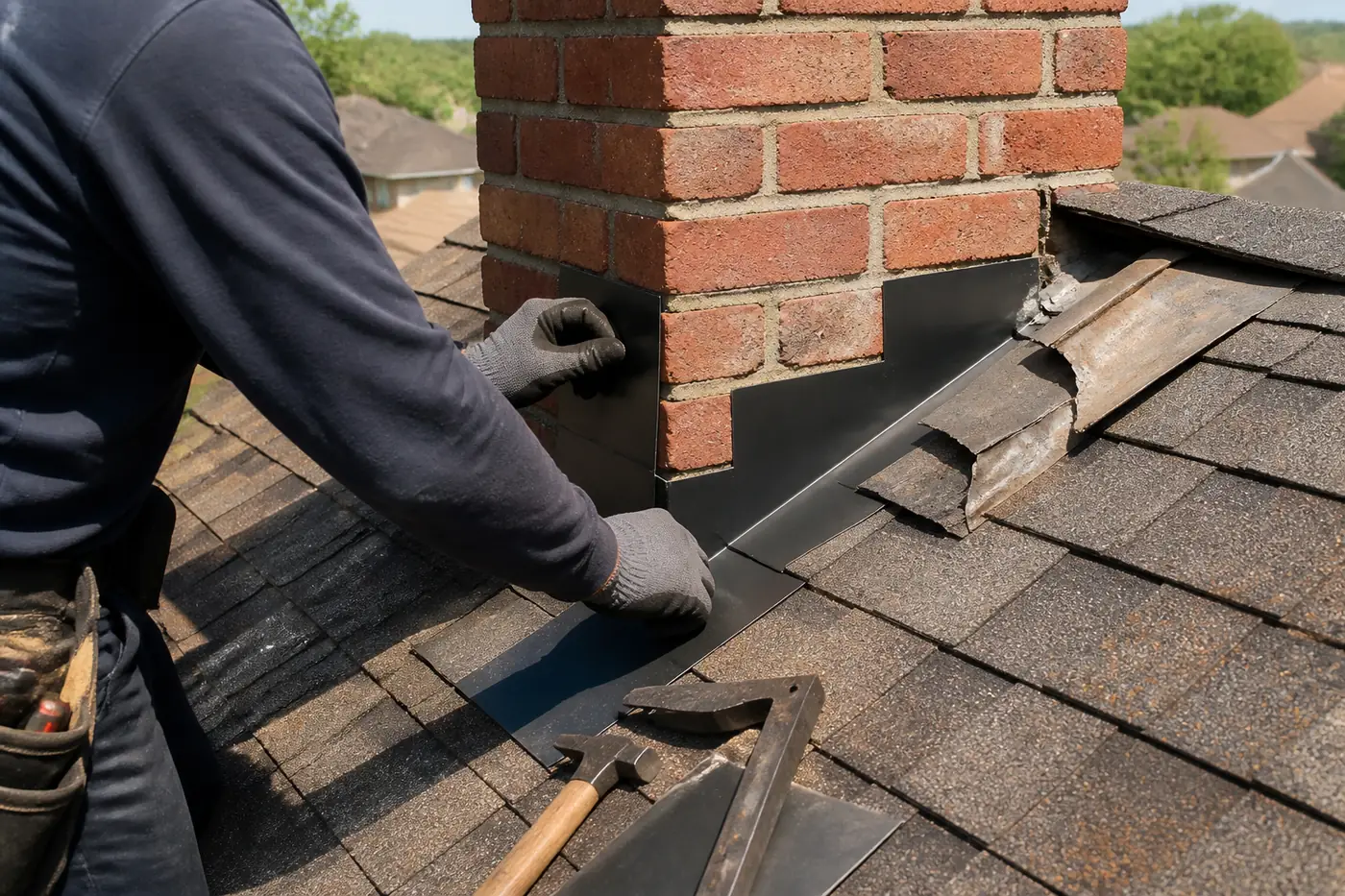
Quick answer: A chimney flashing replacement in Dallas-Fort Worth costs $800 to $2,500 in 2026, with a free written quote before any work begins.
Flashing is the metal that seals the joint where your chimney comes through the roof. It is the busiest waterproofing detail on a house, and it is the one most often done badly.
If the metal is sound and the failure is at the seal, flashing repair is the right call and we will tell you so. Replacement is for when the metal itself has failed: rusted through, pulling away from the masonry, installed wrong from the beginning, or buried under so many previous layers of tar and caulk that nobody can tell what is underneath. At that point, sealing it again is taking your money to postpone the problem.
Individual pieces of metal, one per shingle course, woven up the side of the chimney as the roof rises. Each piece laps the one below it. It is fiddly, it takes time, and it is the part that gets skipped by people in a hurry.
The second layer, and the part that separates a real job from a bad one. Counter flashing is cut into a groove in the mortar joint, bent down over the step flashing, and sealed. It is what keeps water from getting behind the metal.
That groove is the whole thing. Flashing that is simply caulked to the face of the brick will fail, because caulk is the only thing holding it and caulk has a service life measured in a few years. Flashing let into the mortar joint is mechanically anchored and lasts decades.
The apron seals the low side. On a wider chimney, a cricket, which is a small peaked structure behind the chimney, diverts water around it rather than letting it pool against the back wall. Chimneys without crickets that need them are one of the most common sources of persistent leaks we find.
That last one deserves emphasis. If a roofer is putting a new roof on your house, replacing the chimney flashing at the same time costs a fraction of doing it separately later, because the shingles are already off.
We remove the old flashing entirely, including whatever tar and caulk has been layered on over the years, and get down to clean masonry and a clean roof deck. Then we cut a proper reglet into the mortar joint, install new step flashing woven into the shingle courses, install counter flashing into the groove, and seal it with a high-grade sealant that is doing a supporting job rather than the whole job.
Everything is photographed as we go, including what was underneath, which is usually the part that explains why the chimney has been leaking for years.
If the metal is sound, yes, and we would rather do the cheaper job. If the metal is gone, repairing it is not a saving, it is a delay with a cost attached. We will show you photos and let you decide with the actual evidence in front of you.
Either can do it, and the question is who does it properly. A chimney company treats flashing as one of five possible water entry points and checks the crown, cap, and masonry at the same time. That is why homeowners who go the roofer-only route sometimes get new flashing and still have a leak.
Shingles have to be lifted to weave step flashing correctly, and we put them back properly. Any shingle that cannot be reused gets replaced. A flashing job that does not disturb the shingles at all is a flashing job that was caulked on top, which is exactly the failure we are here to correct.
Flashing cut into the mortar joint and installed correctly lasts decades, which is the entire argument for doing it right rather than sealing it again.
Flashing failures are sneaky because the water rarely appears in the fireplace. It runs between the chimney and the roof deck, soaks into the sheathing and the framing, and shows up as a ceiling stain several feet away, or as nothing at all until the drywall gives. By the time it is obvious, the repair is a framing repair.
The Chimney Safety Institute of America identifies water as the leading cause of chimney and structural deterioration, and the National Fire Protection Association recommends annual inspection so failures like this are caught while they are still a metal problem rather than a lumber problem.
"Very pleased with the professionalism and promptness of service. The chimney sweep was done quickly and efficiently at significantly less cost than the first quote I got from another company. Happy to recommend Lowes Chimney Sweep to anyone in Plano!"
"Outstanding chimney sweep service from start to finish. They were punctual, courteous, and left our chimney spotless with no mess in our home. I won't use anyone else for chimney services in Dallas TX!"
More reviews from homeowners across the metroplex are on our reviews section, or learn more about our team before you book.
When the metal itself has failed: rusted through, pulling away from the masonry, originally installed without being cut into the mortar joint, or buried under layers of tar from previous repairs. If the metal is sound and only the seal has failed, repair is the honest and cheaper answer.
Step flashing is the layer woven into the shingle courses up the side of the chimney, one piece per course. Counter flashing is the second layer, cut into a groove in the mortar joint and bent down over the step flashing. Without counter flashing let into the mortar, water eventually gets behind the metal.
Because caulk alone is not a permanent attachment. Flashing sealed to the face of the brick relies entirely on the sealant, which has a service life of a few years. Flashing set into a cut groove is mechanically anchored and lasts decades. This single detail separates a real flashing job from a temporary one.
Yes, and it is the best time to do it. The shingles are already off, which removes most of the labor. Replacing chimney flashing during a re-roof costs a fraction of doing it as a standalone job later, and it prevents the very common situation of a brand new roof leaking at the chimney.
Yes, and many do it well. The advantage of a chimney company is that flashing is only one of five ways a chimney leaks, and we check the crown, cap, chase cover, and masonry at the same time. Homeowners who replace flashing and still have a leak usually had a different source all along.
A cricket is a small peaked structure built behind a chimney to divert water around it instead of letting it pond against the back wall. Wider chimneys generally need one, and a missing cricket is a common cause of leaks that survive multiple flashing repairs.
It depends on the size of the chimney, the roof pitch, whether a cricket is needed, and how much old tar and failed material has to be removed first. We inspect, photograph, and quote a real number before starting, and that number does not change.
A standard chimney flashing replacement is typically a single-day job. Steep roofs, large chimneys, and crickets add time. We tell you the timeline before we start rather than discovering it halfway through.
We serve 98 cities across the Dallas Fort Worth metroplex, seven days a week from 8 AM to 8 PM. Check our service areas or call and we will confirm we cover you.
If the metal is still sound, flashing repair is the cheaper and more honest fix. Flashing is only one of five ways water gets in, so if you are still leaking afterwards the answer is usually crown repair, a missing chimney cap, a rusted chase cover, or porous masonry that needs tuckpointing and waterproofing. When the source is unclear, start with chimney leak repair or a full chimney inspection. Real jobs are documented on our before and after gallery.
New metal, cut into the mortar joint, photographed at every stage. Seven days a week across 98 DFW cities.
Call (214) 225-8874When we lift old flashing and find layer upon layer of roofing tar, we know the history of that chimney without being told. Tar is what gets applied when someone wants the leak to stop today and does not want to pull shingles. It works for a season or two, then cracks, and the next person applies more. The chimneys with the worst rot underneath are almost always the ones with the most tar on top.
Water running down a roof hits the uphill side of the chimney and has to go somewhere. Without a cricket to divert it, it ponds there, sits against the masonry and the flashing, and finds the weakest point. If a chimney is going to leak at the flashing, it usually starts at the back.
Real step flashing is many small pieces, one per shingle course. A single continuous L-shaped strip run up the side of a chimney is faster to install and it is wrong, because it has no way to shed water that gets under the shingles. When we see it, we know the job was done for speed.
A properly built flashing assembly would keep most water out with no sealant at all, because the geometry does the work: metal laps metal, water runs downhill. Sealant fills the last small gap. When sealant is doing the whole job, the assembly is wrong, and the clock started ticking the day it was installed.
The most valuable photo we take on a flashing job is the one after the old metal comes off, showing the rotted sheathing or the water-stained framing that nobody knew was there. It is the difference between a homeowner believing a repair was necessary and a homeowner wondering if they were sold something.
If you are re-roofing and the roofer offers to reuse the existing chimney flashing, think hard. The shingles are already off, which is most of the cost of the job. Replacing it then is inexpensive. Replacing it in three years, when the new roof starts leaking at the chimney, means paying someone to take a new roof apart.
Straight answers from our DFW chimney pros before you book.
Get an honest ballpark range for this service, no phone call needed. Built from real Dallas-Fort Worth pricing, then book when you’re ready.
Get My Instant Estimate →