● Pricing reviewed & current for October 2026
A fireplace can look perfectly fine and still be venting carbon monoxide into your living room. An inspection is thirty minutes that tells you the truth, with photographs.
A fireplace inspection in Dallas-Fort Worth costs $99 to $199 in 2026, depending on the level of inspection your system needs.
A fireplace inspection is focused on the appliance itself: the firebox, the refractory panels, the damper, the hearth extension, the gas connections and burner if you have them, and the way the unit vents. It answers one question directly. Is it safe to light a fire in this thing?
That is related to, but not the same as, a chimney inspection, which looks at the flue, liner, crown, cap, and masonry above the roofline. Most homeowners need both, and we generally do them together, because a fireplace and its chimney are one system and a problem in either one shows up as a problem in the other.
Refractory panels crack, and cracked panels are a real safety issue, not a cosmetic one. Panels exist to contain heat. When they crack through, heat reaches the framing behind them. A crack you can slip a coin into is a condemn, and we will tell you that plainly.
It should open fully, close fully, and stay where you put it. A damper stuck partly closed is the most common cause of a smoky room, and a damper stuck open is quietly costing you money on heating and cooling all year.
The non-combustible surface in front of the fireplace exists to catch embers, and it has to extend far enough. Remodels are where this goes wrong. We see beautiful new hardwood running right up to the firebox opening more often than you would think.
On a gas unit we check the connection for leaks, inspect the burner and pilot assembly, verify the logs are positioned as the manufacturer intended, and look at how the unit is venting. A gas fireplace that is sooting is telling you something is wrong with combustion.
This is the part that actually matters and the part homeowners cannot check themselves. A blocked or deteriorated vent on a gas appliance does not announce itself. There is no smell and no smoke. It is the single reason we tell people that an annual inspection on a gas fireplace is not optional, even though gas produces almost no creosote.
Before the first fire of the season, every year, is the baseline recommendation and it is the one the National Fire Protection Association makes. Beyond that, there are moments when an inspection stops being routine and becomes urgent.
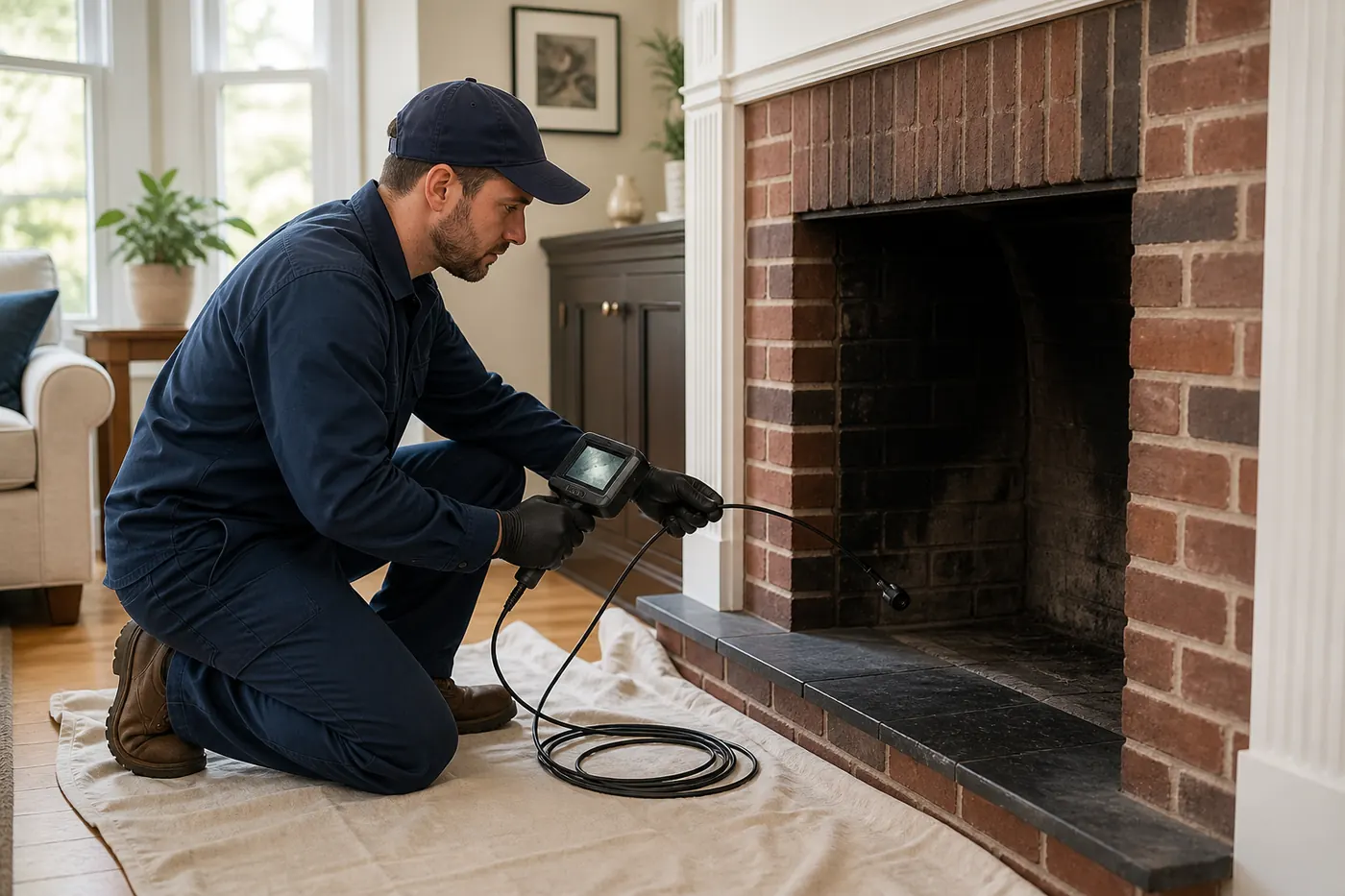
Floors get covered. The technician works through the firebox, damper, hearth, and, on gas units, the burner and connections, then checks how the appliance vents. Every finding gets photographed.
Then you get told the truth in plain language, sorted into three buckets: what is urgent, what can reasonably wait, and what is purely cosmetic. You do not get a list of everything we could possibly sell you. Plenty of our inspections end with us telling the homeowner the fireplace is fine and we will see them next year.
A standard fireplace inspection takes about thirty to forty five minutes. Combined with a chimney sweep, plan on ninety minutes for the visit.
No, and we know that is what people are worried about. Every finding comes with a photograph, so you are never taking our word for it. If we cannot show it to you, we do not charge you to fix it.
We tell you, we show you, and we tell you whether it is safe to use the fireplace in the meantime. Then you decide. We do not do the routine of discovering an emergency and requiring a signature before we leave.
Yes, and this surprises people. Water intrusion, animal nesting, and masonry deterioration happen whether or not you light a fire. Most of the expensive problems we find are water problems, not soot problems.
Yes, and gas units arguably need it more, not less. There is no creosote to warn you and no smoke to see. The venting and combustion check is the entire point.
We are a Plano-based local company, not a franchise routing your call to whoever is closest. Our technicians are background checked, they cover your floors, and they document what they find. The Chimney Safety Institute of America recommends an annual inspection for exactly the reasons above, and we treat that as the standard rather than as an upsell.
We work seven days a week, 8 AM to 8 PM, across 98 DFW cities, and the price we quote you on the phone is the price you pay at the door.
"Very pleased with the professionalism and promptness of service. The chimney sweep was done quickly and efficiently at significantly less cost than the first quote I got from another company. Happy to recommend Lowes Chimney Sweep to anyone in Plano!"
"Outstanding chimney sweep service from start to finish. They were punctual, courteous, and left our chimney spotless with no mess in our home. I won't use anyone else for chimney services in Dallas TX!"
More reviews from homeowners across the metroplex are on our reviews section, or learn more about our team before you book.
A fireplace inspection in Dallas-Fort Worth costs $99 to $199 in 2026, depending on the level of inspection your system needs. We give you the price up front, inspect thoroughly, and photograph every finding, so there are no surprise charges.
We check the firebox and refractory panels for cracks, test the damper, verify hearth extension and clearances, and on gas units inspect the connections, burner, pilot, and log placement. We also check how the appliance vents, which is the part that matters for carbon monoxide and the part you cannot check yourself. Every finding is photographed.
A fireplace inspection looks at the appliance: firebox, damper, hearth, gas components. A chimney inspection looks at the flue, liner, crown, cap, and masonry above the roof. They are two halves of one system and we generally do them in the same visit.
Once a year, before the burning season, whether you use it heavily or barely at all. That is the National Fire Protection Association recommendation, and it holds for gas fireplaces too, because venting problems on a gas appliance give no warning signs.
Yes, and this is the one people skip. Gas produces almost no creosote, so there is nothing dirty to alarm you, but a blocked or deteriorated vent on a gas appliance is a carbon monoxide risk with no smell and no smoke. The venting check is the reason the inspection exists.
If it has been more than a year, or if you have never used it in this house, we would rather you did not until someone looks at it. A cracked refractory panel or a partially blocked vent does not look like anything from your couch.
You get a photo, a plain explanation, and an honest sort into urgent, can wait, or cosmetic. Then you decide what to do and when. We will also tell you whether the fireplace is safe to use in the meantime, which is usually the question people actually want answered.
It is one of the smartest inspections you can add. General home inspectors typically look at a fireplace briefly and are not chimney specialists. Cracked panels, a failed liner, or an unsafe gas connection are expensive surprises to inherit, and documenting them before closing gives you real negotiating room.
Roughly thirty to forty five minutes on its own. If we are combining it with a chimney sweep, plan on about ninety minutes total for the visit.
We serve 98 cities across the Dallas Fort Worth metroplex, seven days a week from 8 AM to 8 PM. Check our service areas or call and we will confirm we cover you before scheduling.
A fireplace inspection is usually paired with a chimney inspection, since the appliance and the flue are one system. If the firebox comes back with cracked panels, that is handled through fireplace repair, and gas units are covered under gas fireplace repair. If the inspection turns up creosote, you want a chimney sweep, and if it turns up soot and staining in the firebox itself, fireplace cleaning handles that. You can see documented work on our before and after gallery, and our guide on what a chimney inspection includes walks through the process in detail.
Firebox, damper, venting, gas connections. Photographed, explained plainly, no pressure. Seven days a week across 98 DFW cities.
Call (214) 225-8874Refractory panels are not decoration. They exist to contain the heat of the fire and keep it away from the wood framing behind the fireplace. A panel cracked all the way through is a path for heat to reach that framing. We measure the crack, and if you can fit a coin edge in it, the fireplace should not be used until it is fixed. That is not a sales pitch, it is the standard.
A properly burning gas fireplace has a defined flame with blue at the base. A flame that is uniformly yellow, lazy, and sooting the logs is telling you combustion is incomplete, and incomplete combustion is how carbon monoxide gets produced. That symptom always earns an inspection, not a wait-and-see.
We find more clearance violations after renovations than after any other event. New flooring runs up to the firebox opening, a beautiful new wood mantel gets installed too close to the top of the opening, or a hearth extension gets shortened to make the room look better. The room looks great and the fireplace is now out of code.
A damper stuck open is an open hole in your house. In a Texas August, that is conditioned air leaving and hot air arriving, all day, every day. People treat a bad damper as a winter problem. It is a year-round bill.
Because the entire chimney trade has a trust problem, and it is earned. Homeowners cannot see their own firebox panels or their own venting, which makes it easy for a dishonest company to invent a crisis. A photograph removes that possibility completely. If we say it is cracked, you will be looking at the crack.
That everything is fine. It happens constantly and it is a perfectly good outcome. You paid for information and the information is that your fireplace is safe. Come back next year.
Straight answers from our DFW chimney pros before you book.
Get an honest ballpark range for this service, no phone call needed. Built from real Dallas-Fort Worth pricing, then book when you’re ready.
Get My Instant Estimate →